Endpoint Detection & Response Is Table Stakes Security

May 22, 2026
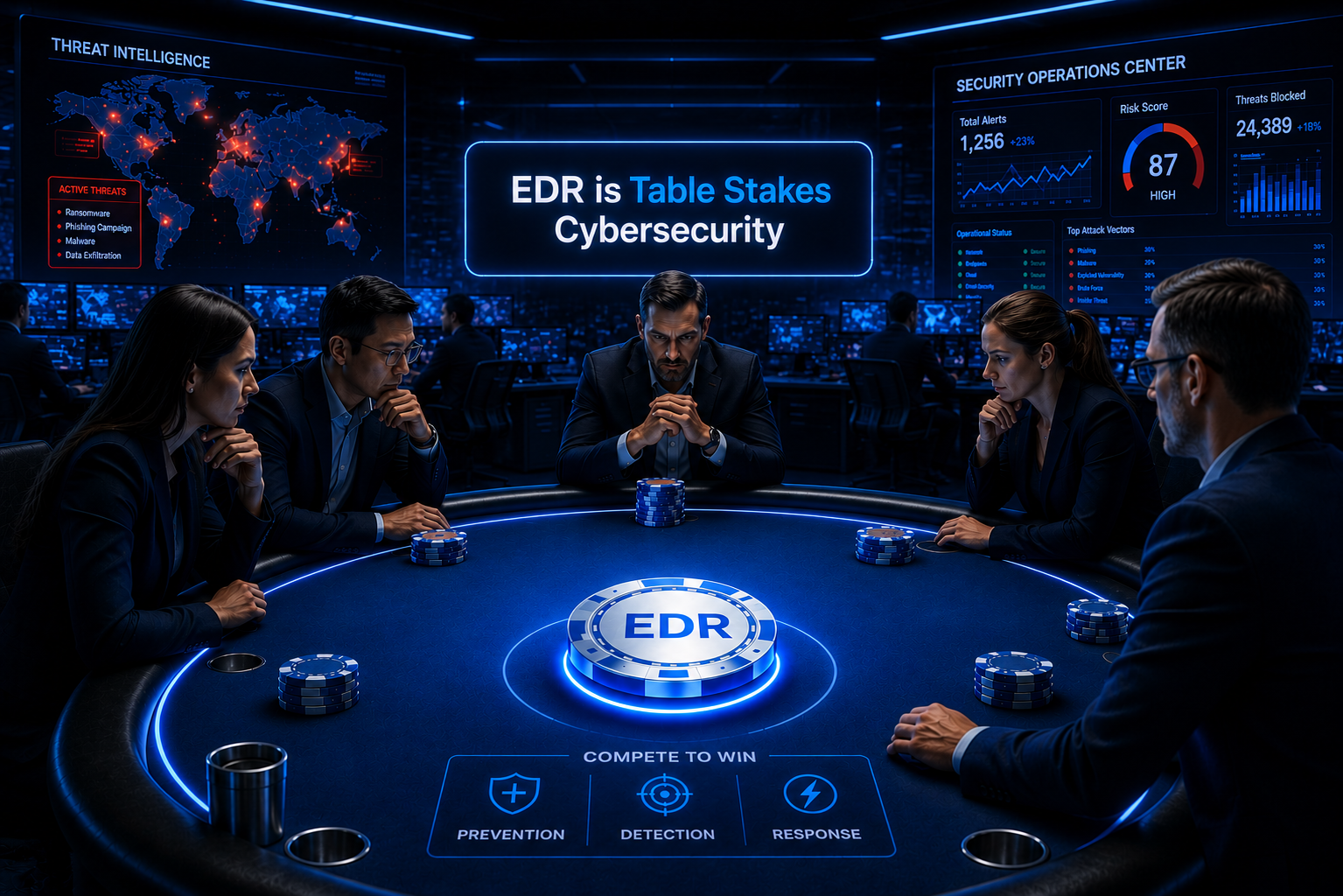
New Bitdefender research reveals that 97.7% of respondents use endpoint detection & response (EDR). This seems high when compared to generally accepted market penetration estimates of the technology, especially in mid-market organizations. However, this is further confirmation that the vast majority of businesses today have already upgraded their endpoint protection.
This is hardly surprising, as the conversation is no longer just about blocking malware or stopping known threats. It is about proving the organization can detect, investigate, and respond to modern attacks before they escalate into operational disruption, financial loss, or reputational damage.
This shift was driven by a new reality: endpoint protection alone is no longer enough, and the laggards, likely mid-market organizations with lean IT and security teams, are now realizing this.
Threat actors are AI-enabled, more evasive, and increasingly successful at bypassing traditional defenses. At the same time, customers, business partners, insurers, and regulators now expect organizations to demonstrate operational cyber resilience across prevention, detection, and response. And if you are breached, you’ll probably need to prove your cyber resilience in court.
As a result, many mid-market organizations still relying only on endpoint protection platforms (EPP) are now wondering: If an attack bypasses this, what happens next?
For organizations without detection and response capabilities, the answer is often unclear — and that uncertainty creates operational risk.
Why Is Endpoint Protection Alone No Longer Enough?
Endpoint protection remains foundational to cybersecurity because it continues to block large volumes of threats and reduce overall exposure. But modern attacks increasingly evade these controls through credential abuse and techniques like Living-off-the-Land (LOTL), which misuse legitimate administrative tools and blend into normal activity.
The challenge is no longer simply stopping threats at the perimeter and blocking them pre-execution on the endpoint. It’s about responding rapidly to AI-enabled attacks and understanding whether attackers have already established persistence, escalated privileges, or compromised critical systems without triggering obvious alerts.
Why Are Organizations Not Deploying EDR?
Many mid-market organizations understand the importance of EDR but lack the team to implement it effectively. Detection and response require continuous monitoring, investigation, prioritization, and rapid decision-making. However, most security teams already feel over-alerted and understaffed. In fact, a 2026 Bitdefender survey found that 45% of IT and cybersecurity professionals agree with this statement: “We struggle to investigate alerts from our security tools.”
For lean IT and security teams, the challenge becomes even greater.
Most mid-market organizations simply do not have:
- A security operations center (SOC)
- Experienced analysts
- Time to investigate every alert
- The budget to build 24x7 monitoring internally
As a result, organizations often find themselves stuck in the middle. They recognize that operating without detection and response creates risk, but they also know they lack the resources to fully manage it internally.
What Are the Risks of Staying with Endpoint Protection Alone?
Maintaining an endpoint protection-only approach creates both operational and commercial risk. Organizations relying on it alone face a higher likelihood of undetected ransomware, longer recovery times, and greater financial exposure when incidents occur. Without continuous monitoring and rapid-response capabilities, sophisticated attacks can remain dormant within environments before escalating into full-scale breaches.
Commercial implications are becoming equally important. Many organizations are now expected to demonstrate continuous monitoring, incident response readiness, and operational resilience as part of supplier onboarding, cyber insurance qualification, and regulatory compliance initiatives.
Prevention alone often does not satisfy those expectations.
As a result, organizations increasingly risk losing business opportunities not because they were breached, but because they cannot demonstrate adequate security maturity.
How Are Organizations Addressing This Gap?
Many small and mid-market organizations are addressing this gap by combining endpoint protection with Managed Detection and Response (MDR). Rather than attempting to build internal SOC capabilities from scratch, organizations are leveraging MDR to gain continuous monitoring, expert-led investigation, threat hunting, and rapid response without increasing internal headcount or operational complexity.
This approach allows organizations to strengthen security posture across prevention, detection, and response while improving visibility into sophisticated attacks and reducing operational burden on internal teams. It also helps organizations improve cyber insurance readiness, strengthen compliance positioning, and build greater trust with customers and business partners.
Importantly, MDR changes the role of security operations from reactive alert management to continuous operational resilience.
Instead of simply receiving alerts, organizations gain access to security experts who actively investigate suspicious behavior, correlate attack activity, and respond before incidents escalate into significant disruption.
How Does MDR Improve Security Without Increasing Complexity?
For lean teams already using Bitdefender endpoint protection, adding MDR is not about replacing infrastructure or creating complexity. It is about extending the value of the existing GravityZone platform into the realm of continuous detection and response.
If you are not yet a Bitdefender GravityZone customer and are looking to migrate to one of the most trusted and proven endpoint protection platforms (EPP) and add detection and response capabilities, consider Bitdefender GravityZone MDR.
Bitdefender GravityZone MDR combines 24x7 monitoring and response with AI-enabled threat detection, expert-led investigations, threat hunting, rapid containment actions, and guided remediation recommendations. This provides continuous visibility across the attack lifecycle while reducing the operational burden placed on your team.
The result is stronger security outcomes, faster response when attacks occur, and significantly reduced uncertainty for organizations that lack the resources to manage modern detection and response internally. And it’s much more cost-effective than building an in-house SOC.
What Business Outcomes Are Organizations Achieving with MDR?
Organizations that move to a combined prevention, detection, and response model achieve measurable operational and commercial benefits.
These include:
- Reduced risk of successful ransomware and data breaches
- Faster detection and containment of sophisticated attacks
- Lower operational burden and reduced burnout for internal IT and security teams
- The ability to demonstrate cyber resilience to customers and partners
- Stronger compliance and cyber insurance positioning
- Reduced recovery costs and operational disruption because incidents are rapidly contained
For many organizations, the shift is larger than technology alone. They are moving from relying solely on prevention — to building continuous operational resilience capable of responding to modern attacks in real time.
And in today’s threat landscape, that shift is rapidly becoming essential.
Strengthen Your Security Posture Without Increasing Operational Complexity
Learn how Bitdefender GravityZone MDR helps our customers extend protection into continuous detection and response while improving resilience, reducing risk, and supporting business growth.
Read Now: The Business Case: From Endpoint Protection to Managed Detection and Response
If you are not yet a Bitdefender customer, learn more about Bitdefender GravityZone MDR.
tags
Author
Duncan Mills is Senior Director, Go-to-market Strategy, at Bitdefender. He has more than 20 years of experience across global technology and cybersecurity markets, helping organizations align security innovation with business outcomes.
View all postsYou might also like
Bookmarks
