WhiteArmor gang claims responsibility for latest cyber attack on shipping giant Maersk

November 12, 2026
Shipping giant Maersk has confirmed that one of its systems was broken into by hackers who have stolen data.
In a statement published yesterday on its website, the company said that it had detected the unauthorised access to a "local legacy system". The Danish company has not said which system was hit, what data was taken, or when the security breach occurred.
The firm has, however, said that it has seen no sign that the breach involved other Maersk systems, or that shipments have been impacted. To date, Maersk says that it has not seen any evidence that any sensitive information has been breached.
Responsibility for the attack has been claimed by the WhiteArmor cybercrime group, which has listed Maersk on its dark web leak site. There it demanded a ransom equivalent to US $5 million be paid within 30 days, for the 100GB worth of data it claims to have stolen from a platform built by LF Logistics, a firm that Maersk acquired in 2022.
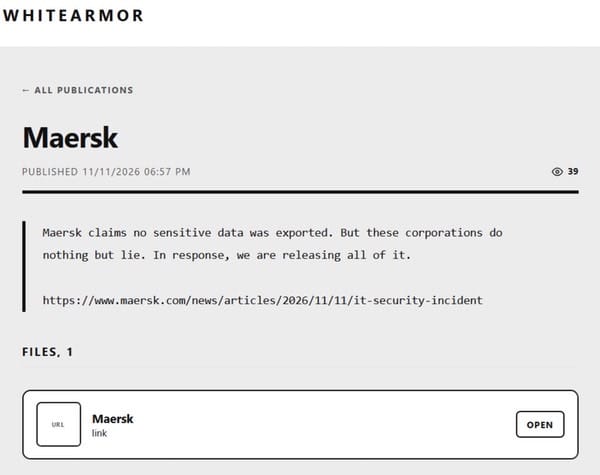
WhiteArmor is a relatively new cyber-extortion group, having emerged late last month, but it is already claiming more than a dozen victims on its leak site including Chinese electronics and home appliance manufacturer Hisense.
According to WhiteArmor, its data haul from Maersk includes nearly 30,000 driver records, plaintext passwords, purchase orders, advance shipping notices, signed delivery receipts, and 27,842 mobile device records containing phone numbers, email addresses, and IMEI numbers.
While Maersk has not confirmed the veracity of the hackers' claims, it is advising customers and partners to treat unexpected messages about the security breach with caution, and to always verify with a trusted contact at the company before taking any action.
Regular readers of the Hot for Security blog will be well aware that this is not Maersk's first brush with cybercrime.
In 2017, the company was hit by the NotPetya malware attack which forced the firm to reinstall more than 4000 servers and 45,000 workstations, and ended up costing it up to US $300 million.
On this occasion the breach appears to have happened because of IT systems inherited from an acquisition. As such it serves as a salutary reminder that when you buy a company you also buy its IT systems, and any security problems which may lurk within them.
tags
Author

Graham Cluley is an award-winning security blogger, researcher and public speaker. He has been working in the computer security industry since the early 1990s.
View all postsYou might also like
Bookmarks
