The safest way to pay a stranger online: a risk-ranked payment checklist

September 09, 2026
Paying a stranger online rarely comes down to finding a “safe” app. More often it’s about choosing a payment route that gives you a means of recourse if the deal is fake. It’s usually safest through a reputable marketplace or purchase-protected checkout, ideally by credit card. Here’s how the options rank.
Key takeaways
- The safest payment route combines a legitimate marketplace or checkout with buyer protection and a payment method that allows disputes
- Scammers often try to move transactions off-platform or steer buyers toward transfers that are difficult to reverse
- Bank transfers, personal payment-app transfers, wire transfers, gift cards and cryptocurrency generally provide less recourse than protected purchases
- Before you pay, verify the seller, confirm exactly what protection applies and keep the transaction, messages and receipts inside the official platform
What is the safest way to pay a stranger online?
There is no completely risk-free way to pay a stranger. The safest option is generally a reputable marketplace’s own checkout with applicable buyer protection, preferably using a credit card where that is supported.
The US Federal Trade Commission (FTC) advises marketplace buyers to use credit cards or secure payment systems with buyer protection. It also warns against leaving a marketplace’s payment system because doing so can remove platform protections. The UK National Cyber Security Centre (NCSC) similarly recommends credit cards for online purchases and advises against direct bank transfers.
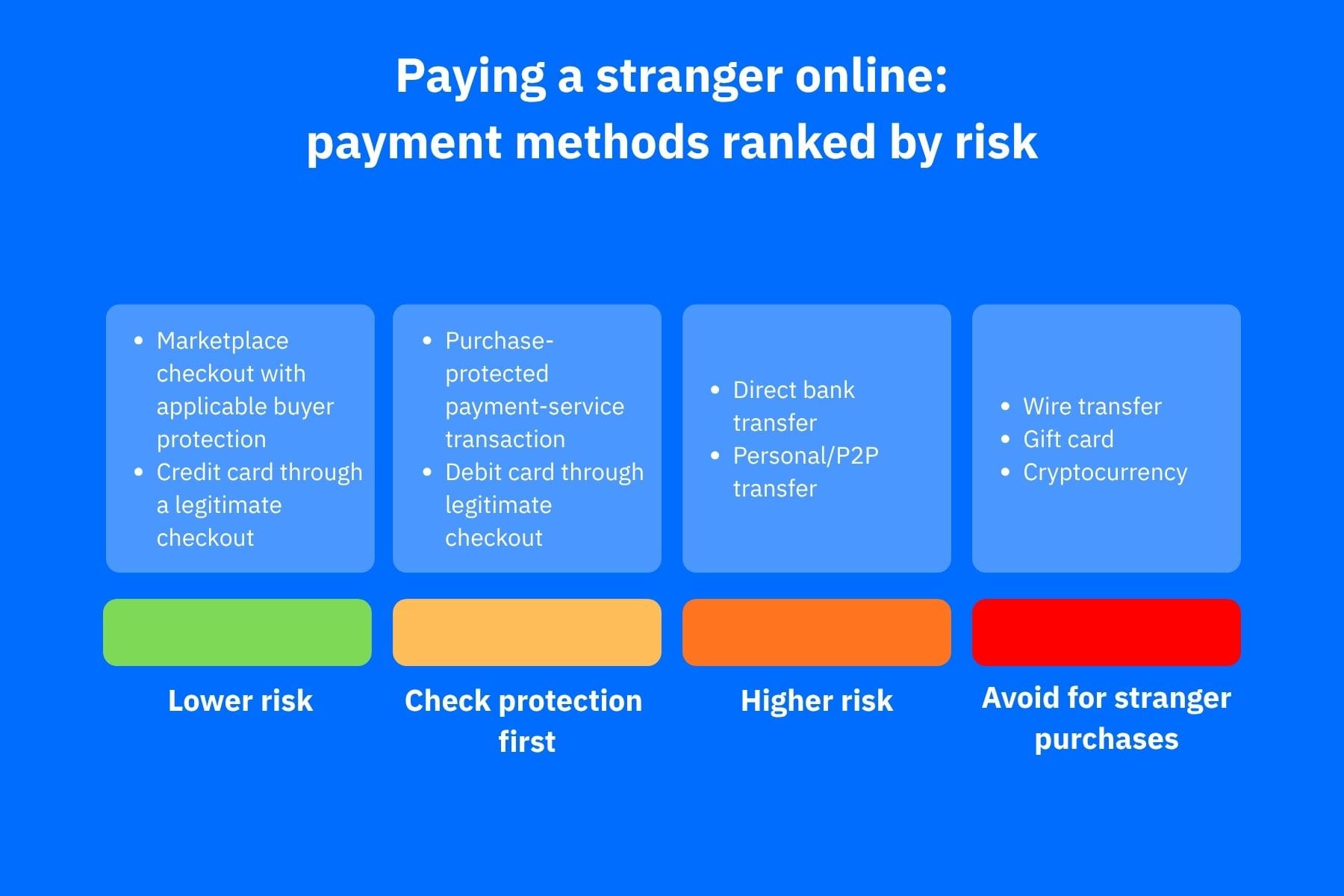
A practical risk ranking is:
- Lowest risk: marketplace checkout with buyer protection. Keep payment and communication inside the platform. Check that the specific item and transaction qualify for protection.
- Low risk: credit card through a legitimate checkout. Credit cards generally offer stronger dispute options than payments that function like cash, although exact legal rights depend on your country.
- Moderate risk: a payment service’s protected purchase option. For example, PayPal says eligible Goods and Services payments can receive Purchase Protection, while Friends and Family payments do not.
- Moderate-to-higher risk: debit card through a legitimate checkout. Chargeback or similar mechanisms may be available, but protections vary by jurisdiction and card scheme.
- High risk: direct bank transfers or personal P2P payments. The CFPB currently advises consumers in the US to use mobile payment apps only with people they know and trust.
- Avoid for purchases from strangers: wire transfers, gift cards and cryptocurrency. Regulators repeatedly warn that these methods can make recovery especially difficult.
Keep in mind that a technically secure transfer can still send money perfectly and instantly to a scammer.
Why scammers try to control how you pay
Payment scams often start with an attractive listing, ticket, rental, collectible or other deal. The seller then creates a sense of urgency or proposes a discount if you leave the marketplace and pay directly.
Also take it as a warning sign if you’re told to use a personal-transfer setting rather than a purchase option. That distinction matters: protection programs often have eligibility rules, exclusions and dispute deadlines.
Sellers can be targeted too. The FTC has documented scams involving fake payment notifications, bogus claims that a buyer paid twice, and fake checks for more than the selling price followed by requests to return the “extra” money.
The criminals may be after the payment itself, an item you are selling, card or bank information, login credentials, or verification codes they can use to compromise other accounts.
A five-check rule before you send money
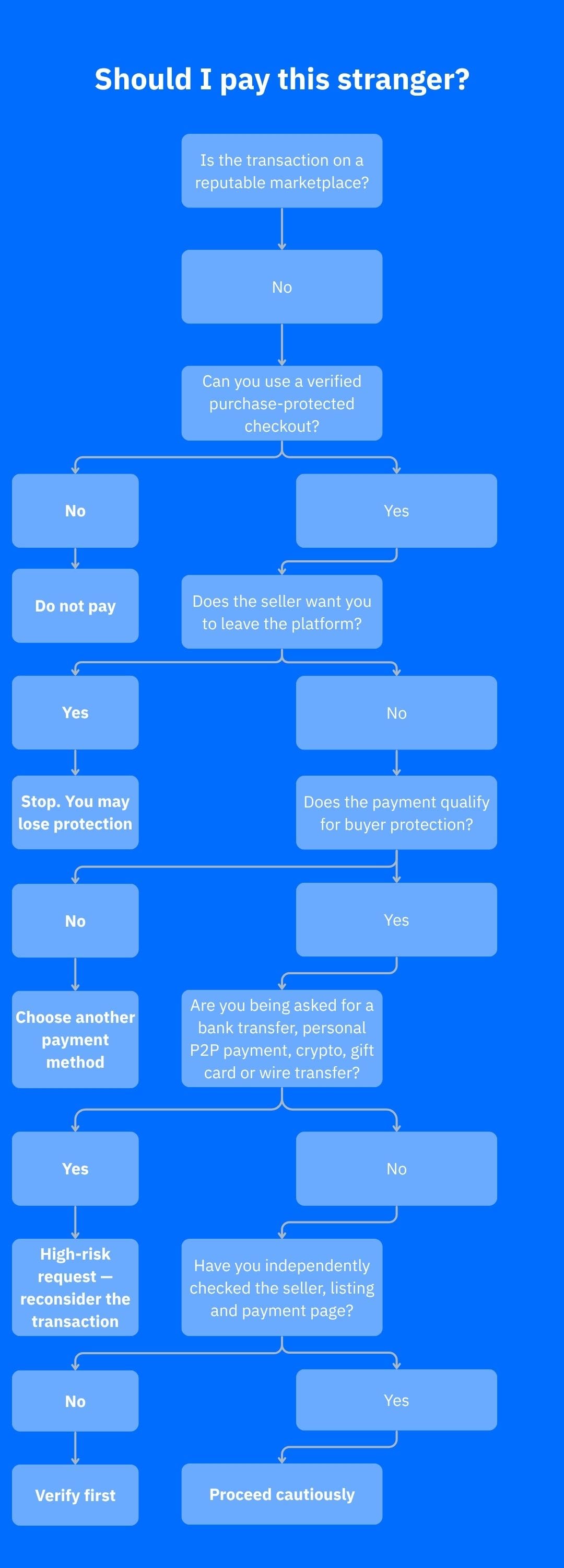
- Stay in the marketplace. Do not move to an external payment method simply because the stranger promises a discount.
- Check the person and listing. Review account history, recent feedback, photos, price and inconsistencies in the seller’s story.
- Read the rules around protection before paying. Confirm that the product, delivery method and payment type are eligible.
- Open payment sites yourself. Do not rely on a checkout link or QR code sent by the stranger when you can navigate to the service independently.
- Keep evidence. Save the listing, messages, receipt, seller details and transaction information in case you need to dispute the payment. See our scam evidence checklist for what to preserve.
A request to pay quickly, leave the platform, use a personal transfer, send an additional “verification” fee or refund an alleged overpayment should stop the transaction rather than accelerate it.
What if you already paid the stranger?
Contact the bank, card issuer, marketplace or payment provider immediately. Report the transaction as a suspected scam and ask what dispute, recall or reversal options are available. Do not send another payment if the stranger says one is needed to unlock a refund.
If you used a bank transfer, follow the steps in our guide on what to do after you’ve sent money to a scammer by this method. The broader scam recovery timeline explains what to prioritize when payment fraud is accompanied by exposed accounts or personal data.
Protections vary widely. For example, the UK has mandatory reimbursement rules for qualifying authorized push payment scams made through Faster Payments and CHAPS, but the rules have scope requirements and exclusions, including some civil disputes.
How Bitdefender can help
If a seller sends a suspicious payment link, QR code, email or message, Bitdefender Scamio can analyze them and provide an assessment before you interact with them.
Bitdefender Ultimate Security includes device-security and scam-protection capabilities that can help identify malicious websites, messages and other scam activity, while Bitdefender SecurePass provides encrypted password management to protect account credentials.
If personal information was exposed in a suspicious transaction, Bitdefender Digital Identity Protection monitors for personal-data exposure and breaches across the public web and dark web.
For creators selling products or arranging commercial relationships through social media, Bitdefender Security for Creators can monitor supported YouTube, Instagram and Facebook accounts for takeover activity and flag phishing attempts. It is an account-security layer, not a substitute for buyer or seller payment protection.
Conclusion
The safest way to pay a stranger online is to choose the transaction structure that leaves you the most options if the other person disappears: stay on a reputable platform, use its protected checkout and favor a credit card or explicitly purchase-protected payment option. If the stranger insists on removing those protections, do not pay.
For more ways criminals manipulate payments, transfers and account access, see our guide to financial scams.
Frequently asked questions (FAQs)
What is the safest way to receive money from strangers online?
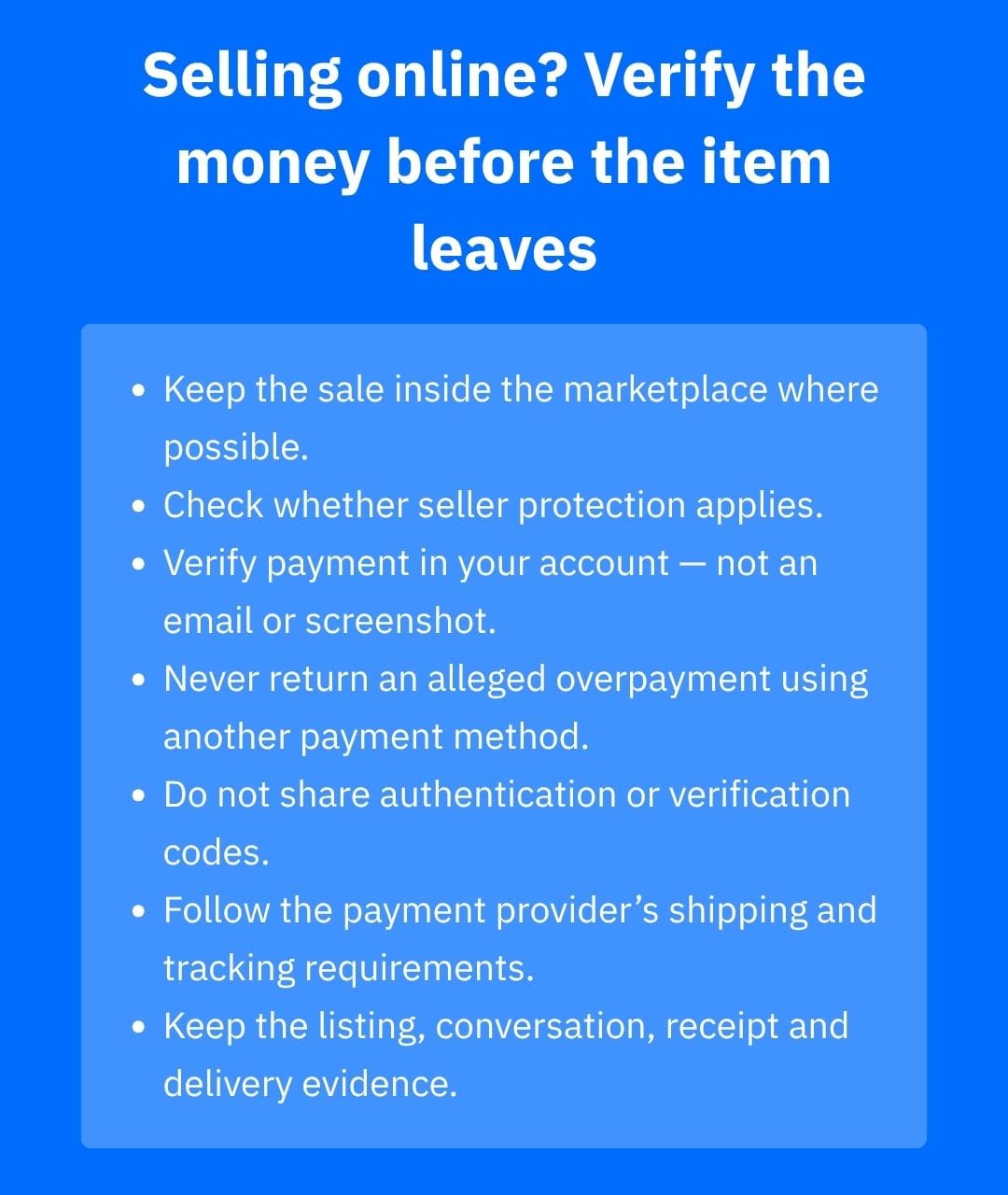
For online sellers, the safest approach is generally a reputable marketplace or payment service that offers seller protection for the specific transaction. Confirm the payment inside your own account before shipping, follow delivery and tracking requirements, and never rely on emailed screenshots. For high-value transactions, a legitimate, independently verified escrow service may also be appropriate.
What's the safest way to pay a stranger?
Use a reputable marketplace’s protected checkout and, where available, pay by credit card. If paying through a standalone payment service, select the option explicitly intended for purchases and confirm that your transaction qualifies for buyer protection. Avoid opting for personal transfers simply because the seller says they are cheaper or faster.
What is the safest payment method for sellers online?
A marketplace or payment provider offering applicable seller protection is generally safer than arranging an informal payment directly with the buyer. Sellers should verify payment in the official platform, ship only according to the provider’s protection requirements, retain proof of delivery and reject overpayments or requests to send money back.
What is the safest method to pay online?
For ordinary online purchases, credit cards through legitimate, encrypted checkouts generally offer strong consumer protections, while established payment platforms may provide additional buyer-protection programs. Protection varies by country and transaction type, so check the terms before paying. Encryption alone does not prove a website or seller is legitimate.
tags
Author

Vlad's love for technology and writing created rich soil for his interest in cybersecurity to sprout into a full-on passion. Before becoming a Security Analyst, he covered tech and security topics.
View all postsYou might also like
Bookmarks
