MSP Strategic Defense: Where Prevention Meets Compliance

February 12, 2026

Imagine a modern office building. Not everyone who works there can go everywhere. Employees can access the building entrance, their own floor, and the meeting rooms they need, but they can’t (and shouldn’t be able to) walk into the server room, access executive offices, or wander freely across every floor. This may seem restrictive, but it’s simply how safety and order are maintained.
Security works best when access is appropriate, contextual, and continuously enforced, not when everyone is trusted with everything. The same principle applies to MSP security environments.
How Do MSP Environments End Up With Too Much Access?
In many MSP-managed environments, endpoints can execute far more tools than necessary, legitimate applications can be misused, security policies are kept broad to preserve workflows, and compliance controls are often documented rather than enforced. In effect, it’s like giving every employee the master key and hoping nothing goes wrong.
This approach creates predictable problems. Prevention becomes reactive because the attack surface is wide open, while compliance becomes theoretical because controls aren’t enforced consistently. MSPs are left chasing alerts, managing exceptions, and preparing compliance evidence after the fact, becoming increasingly swamped by operational overhead.
Why Traditional Prevention Is Breaking Down for MSPs
Traditional prevention relies on static rules such as fixed allowlists, generic hardening baselines, and one-size-fits-all policies. This approach assumes predictable users and stable environments, but MSP environments are anything but static. Users behave differently, roles overlap, tools change constantly, and legitimate software is frequently used as an attack vector.
To keep customers productive, MSPs loosen controls. To stay secure, they tighten them again. The result is friction, operational noise, and increased risk. Just like in the office building analogy, security fails when access is either too open or too rigid.
How Should Modern Prevention Work in MSP Environments?
In a well-run building, access is granted based on role, behavior is expected and predictable, and unusual activity stands out immediately. Levels of access can be adjusted as needed without disrupting daily work.
The real question isn’t whether an application is allowed, but whether an action makes sense in its specific context. This is where adaptive prevention, implemented through dynamic attack surface reduction, is changing the game for MSPs.
How Does Adaptive Prevention Reduce Risk Before Incidents Happen?
Adaptive prevention focuses on learning how users and devices normally operate, identifying tools and actions that are rarely or never needed, and restricting risky behavior without breaking legitimate workflows. It doesn’t block productivity. Instead, it applies dynamic attack surface reduction to remove unnecessary access that could be targeted by attackers.
Users can still do their jobs while attackers lose easy paths. For MSPs, this translates into fewer incidents, fewer alerts, and fewer emergency responses across customer environments. Reducing risk is critical, but MSPs also need to demonstrate that controls are working as intended.
Where Compliance Enters the Story
Now imagine an auditor walking into that office building and asking how you ensure that only authorized people can access sensitive areas. You wouldn’t hand them a policy document and ask them to take your word for it. Instead, you would show access logs, badge permissions, and the mechanisms that actively enforce those restrictions.
Compliance works the same way. Annual assessments, manual screenshots, or static reports that quickly become outdated are no longer enough. Auditors increasingly expect clear proof that controls are not just defined, but continuously enforced.
Can Compliance Keep Up with How Security Really Works?
For MSPs, compliance quickly becomes unmanageable when evidence is collected manually, controls drift between audits, and security posture changes faster than documentation can keep up. What should be a structured process turns into a constant effort to reconstruct what happened after the fact.
The only way compliance truly scales is when it is derived directly from live security controls, continuously updated, and automatically mapped to relevant frameworks. In other words, compliance must reflect how security actually operates, not how it is supposed to operate on paper. This is where prevention and compliance converge.
Where Prevention Meets Compliance: Strategic Defense
When adaptive prevention is in place, dynamic attack surface reduction continuously limits exposure, risky behaviors are restricted automatically, and security controls operate consistently across environments. Built on top of it, compliance visibility maps those same controls to relevant frameworks, automatically generates evidence, and updates the compliance posture in real time.
This is strategic defense in practice. Prevention produces protection, while compliance produces proof.
For MSPs, this model delivers tangible advantages, including lower operational overhead, fewer customer disruptions, stronger audit readiness, and clear differentiation in the market. More importantly, it allows MSPs to move from reactive security to proactive defense, from manual to continuous compliance, and from tactical services to strategic partnerships.
The Future of MSP Security Is Integrated
Prevention and compliance are no longer separate conversations. They are two sides of the same outcome: reduced risk, demonstrable control, and continuous trust. MSPs that align adaptive prevention with real-time compliance visibility don’t just protect customers. They help them feel and prove they are protected.
To see how this model works in real MSP environments, watch our on-demand webinar, MSP Strategic Defense: Where Prevention Meets Compliance.
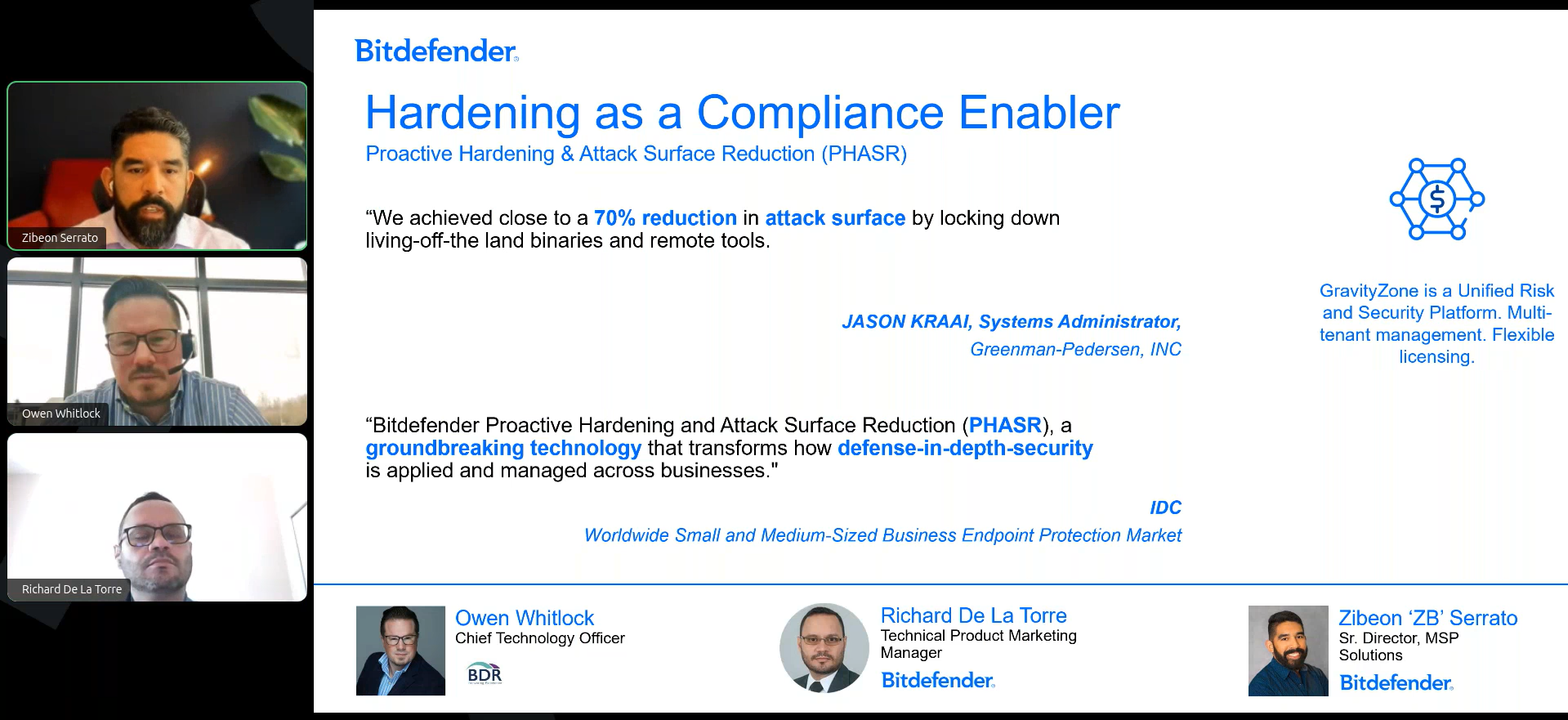
In this session, you’ll learn how adaptive prevention reduces attack surface without friction, how security controls translate into compliance-ready evidence, and how MSPs can scale security and compliance together.
Watch the on-demand session to move beyond checkbox compliance and build a strategic defense model that strengthens security while meeting compliance requirements.
tags
Author
Bitdefender is a cybersecurity leader delivering best-in-class threat prevention, detection, and response solutions worldwide. Guardian over millions of consumer, enterprise, and government environments, Bitdefender is one of the industry’s most trusted experts for eliminating threats, protecting privacy, digital identity and data, and enabling cyber resilience. With deep investments in research and development, Bitdefender Labs discovers hundreds of new threats each minute and validates billions of threat queries daily. The company has pioneered breakthrough innovations in antimalware, IoT security, behavioral analytics, and artificial intelligence and its technology is licensed by more than 180 of the world’s most recognized technology brands. Founded in 2001, Bitdefender has customers in 170+ countries with offices around the world.
View all postsYou might also like
Bookmarks
