Scam Alert: FIFA World Cup Lottery Scams are Back in Business

April 13, 2022

FIFA World Cup lottery scams are fake prize messages that claim you have won money, tickets, grants, or promotional rewards from FIFA, a World Cup committee, sponsor, or “official” lottery. These scams usually arrive by email, text, letter, social media message, or messaging app and ask you to reply with personal information or pay “taxes,” “processing fees,” “customs charges,” or “delivery costs” before receiving the prize. FIFA does not randomly award lottery prizes to people who did not enter an official competition, and any message that asks you to pay or share sensitive data to claim a World Cup prize should be treated as a scam.
Key takeaways
- FIFA World Cup lottery scams impersonate FIFA, tournament organizers, sponsors, or prize committees to make fake winnings look legitimate.
- Common red flags include unexpected prize notices, poor grammar, unofficial email addresses, urgency, fake certificates, and requests for ID copies, banking details, or upfront fees.
- Real prizes are free to claim. If you have to pay taxes, processing fees, shipping, customs, or “clearance” charges before receiving the prize, it is a scam.
- Don’t reply, click links, download attachments, or send money. Report the message and use Bitdefender Scamio to check suspicious World Cup emails, texts, screenshots, or links before engaging.
This month, Bitdefender Labs has spotted a wave of email-based scams exploiting the highly anticipated FIFA World Cup Championship to be held in Qatar in November this year.
The subject lines are as follows:
- The FIFA World Cup Qatar 2022™
- QATAR 2022 FIFA LOTTERY WINNER
- WINNER: Email Owner
Scammers posing as the FIFA World Cup Committee are bombarding inboxes across the globe with phony messages that state you’ve won a hefty prize.
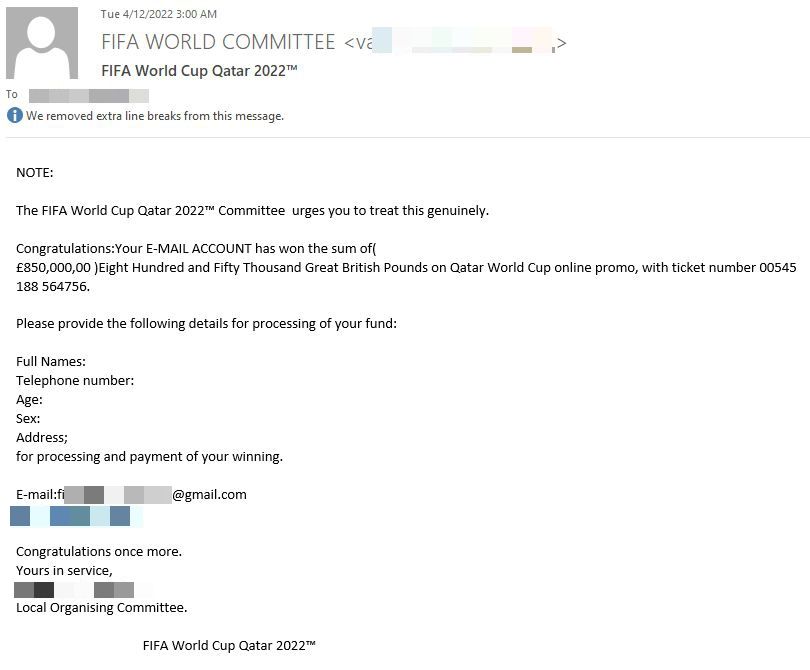
Most of the bogus emails originate from IP addresses in the US. Their main targets are recipients in the UK, Ireland, South Africa, Romania, Sweden and Denmark.
In one variation of this scam, recipients are told they are the lucky winners of $1.5 million.
Apparently, you were selected in the “QATAR FIFA WORLD CUP 2022 GAME PROMOTION Draw held in Istanbul Turkey through an open Computer ballot JAVA System”.
“This Promotional Lottery Draws sponsored by the Hisense, Microsoft and the World Health Organization (WHO) in Collaboration with the Center for Disease Control (CDC) to help provide financial assistance to families across the globe while working hard with so many nations to combat this world Coronavirus pandemic and also to support the coming QATAR FIFA WORLD CUP 2022 GAME,” the phony email reads.
Of course, no FIFA Lotto ticket is mentioned. The email states that you were automatically entered in the draw, “as Microsoft collected all the Active email users globally for this promotion.“
The so-called winners are then asked to contact a claim agent using an email address or phone number provided by the scammer. The recipients need to send a list of personally identifiable information such as their full name, address, age, occupation and phone number.
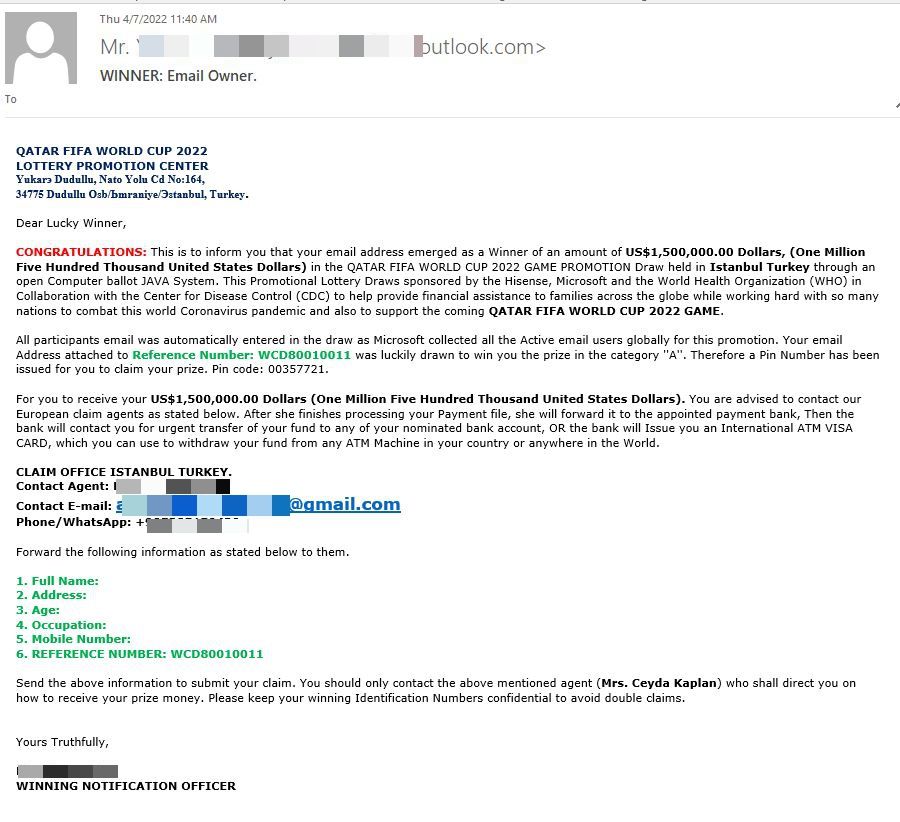
This email is actually a type of advance-fee scam, where the fraudsters usually end up making excuses for why they can’t wire you the money, citing bank processing fees and other pretexts.
How to avoid lottery scams
Advance-fee scammers make money by stalling your supposed financial winnings. The best way for you to protect against lottery scams and similar ruses is to dismiss the correspondence entirely. Look for grammar mistakes and do some research on the so-called lottery. Legitimate organizations and online raffles thrive on publicity. If you haven’t bought a ticket or entered an online competition, it’s 100% a scam. Don’t provide personally identifiable information to individuals who contact you out of the blue stating you’ve won millions of dollars, and never disclose your financial information or pay any processing fees to receive your prize.
Bitdefender protects your household devices from malicious and fraudulent activity of all kinds. To fend off phishing and nasty internet threats and benefit from unlimited VPN traffic alongside a cross-platform Password Manager, check out Bitdefender’s new 3-in-1 full security suite. To prioritize your digital safety and check if your personal information was stolen or made public, add Bitdefender’s Digital Identity Protection to your digital security toolkit. The digital identity and privacy-focused service offers a complete view of your online presence, data breach exposure and privacy risks.
Frequently asked questions (FAQs)
Can I be scammed for a FIFA World Cup 2026 ticket?
Yes. FIFA World Cup 2026 ticket scams can involve fake ticket websites, spoofed FIFA emails, social media sellers, fake resale offers, phishing links, and “lottery winner” messages that claim you won tickets or early access. Scammers may sell tickets they don’t have, send fake QR codes, steal payment details, or ask for extra “processing,” “delivery,” or “verification” fees. To stay safe, buy only through FIFA’s official ticketing channels or verified partners, avoid links in unsolicited messages, and check suspicious offers with Bitdefender Scamio before paying. The FTC warns fans to watch for copycat World Cup websites and scam links.
Is there a FIFA World Cup scam?
Yes. Common FIFA World Cup scams include fake lottery prizes, fake ticket sales, fake hospitality packages, phishing emails, spoof FIFA websites, travel scams, fake merch stores, and fraudulent resale listings. These scams often use FIFA logos, tournament language, urgency, and “limited availability” claims to make victims act before verifying the offer. A real FIFA prize or ticket purchase should not require you to pay unexpected fees, send ID documents through email, or enter payment details on an unofficial website.
How can I be scammed for FIFA World Cup 2026 tickets?
You can be scammed for FIFA World Cup 2026 tickets by buying from fake websites, social media sellers, messaging-app groups, unofficial resale listings, or phishing emails that imitate FIFA or ticket partners. Red flags include prices that are far below market value, pressure to pay quickly, requests for bank transfers or crypto, screenshots instead of verified ticket transfers, unofficial URLs, and sellers who refuse to use a protected payment method. Because digital tickets and QR codes can be faked, verify the seller and purchase channel before paying. Reports around World Cup ticketing have already highlighted spoof FIFA websites and disputes over third-party resale orders, so fans should be cautious outside official channels.
tags
Author

Alina is a history buff passionate about cybersecurity and anything sci-fi, advocating Bitdefender technologies and solutions. She spends most of her time between her two feline friends and traveling.
View all postsYou might also like
Bookmarks
