Meta's Ray-Bans are being banned from pubs, restaurants, and theatres

August 10, 2026
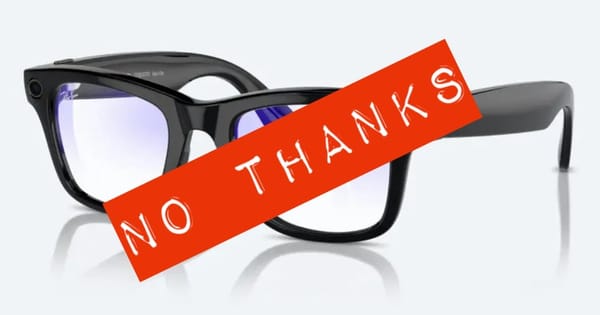
I'm sure you remember "glassholes" - the delightful term coined back in 2013 when Google Glass wearers were being turned away from restaurants and mocked mercilessly online.
Well, history is repeating itself - this time with a product that some people actually seem happy to wear.
Meta's Ray-Ban smart glasses have been a genuine commercial success. Sales have tripled in the past year, with more than seven million pairs sold worldwide. The social media firm has even enlisted Kylie Jenner to promote them, and handed out free pairs to influencers in order push them into the mainstream.
The problem is - and it's a rather significant one - that these glasses look just like ordinary spectacles or sunglasses. That's great for the wearer, for sure. But rather less than wonderful for everyone around them who has no idea that they are being secretly filmed.
As The Guardian reports, a growing number of UK venues have decided to act.
The celebrated London restaurant owner Jeremy King, for instance, whose establishments include Simpsons in the Strand and The Park, said:
"I would never knowingly allow any invasion of guest privacy other than with the eyes we were born with."
Soho House, the global private members' club chain, meanwhile has said that its ban on filming on the premises covers Meta smart glasses. Meanwhile, ATG Theatres - owner of the Bristol Hippodrome, Edinburgh Playhouse, and numerous London venues - says audiences will be asked to remove them during shows.
Wetherspoons chief executive Tim Martin is similarly against the devices:
"Meta glasses seem to breach this code, and common sense, by enabling surreptitious surveillance."
Meta insists it has "built privacy into our AI glasses from the ground up," by including an LED that lights up when filming and cuts the recording if tampered with. Many, however, feel that is still insufficient protection for their privacy.
But the problems go considerably deeper than having a fellow diner filming you while you enjoy your evening out.
Two Swedish newspapers, working with a journalist in Kenya, uncovered that when you used the AI features on the glasses, your audio and video were beamed to Meta's servers.
I imagine that doesn't surprise anyone. But what many users probably did not realise is that from there the content was passed to human workers at a firm called Sama in Nairobi, who labelled what the cameras saw to help train Meta's AI.
Those workers described seeing "everything from living rooms to naked bodies," and detailed how they saw footage of people undressing, and bank cards. One worker described a video where a man removed his glasses, placed them on the bedside table, and walked out - not realising they were still recording as his wife came in and got changed.
Meta's response? To terminate Sama's contract, firing 1,108 staff, because they had spoken to the press.
Meta says it has since moved to a different provider. The lesson apparently learned from years of privacy scandals is simply to do better at keeping it quiet next time.
Earlier this year, it was revealed that Meta has been internally developing a feature called "Name Tag" which would let wearers identify strangers just by looking at them.
An internal memo proposed launching it during a "dynamic political environment" when civil society groups would be too distracted to object. As journalist James Ball put it on an episode of the "Smashing Security" podcast, it was "exactly the sort of stuff that villains write in movies for six-year-olds to make sure they know who the bad guy is."
Regulators are catching up, but slowly. For now, it is Wetherspoons enforcing what Brussels and Westminster haven't. Leave the Ray-Bans at home. The bouncer won't confiscate your pint, but they might confiscate your smart glasses.
tags
Author

Graham Cluley is an award-winning security blogger, researcher and public speaker. He has been working in the computer security industry since the early 1990s.
View all postsYou might also like
Bookmarks
