FBI: Cybercrime Losses Hit a Record $21 Billion Last Year, Fueled by AI

April 08, 2026

Americans reported losing $20.9 billion to cybercrime in 2025—much of it to AI-enabled scams.
The FBI’s latest Internet Crime Complaint Center (IC3) report reveals that cybercrime losses in the U.S. surged to nearly $21 billion in 2025, setting a new record and marking a dramatic jump from the already staggering $16.6 billion reported for 2024.
Scams are becoming more sophisticated, more scalable, and far more profitable than ever.
Key takeaways
- Cybercrime losses reached ~$21 billion in 2025, a new record
- Complaints surpassed 1 million cases for the first time
- Investment scams, phishing, and extortion remain top threats
- Older adults lost $7.7 billion, the most of any age group
- AI and cryptocurrency are accelerating scam effectiveness
A record year for cybercrime
The IC3 received over 1 million complaints in 2025, a sharp increase from roughly 860,000 the previous year.
But what’s more concerning is not just the volume—it’s the impact. Losses have outstripped complaints, signaling that attackers are getting better at extracting larger sums per victim.
Cyber-enabled fraud now accounts for the vast majority of losses, with tactics that blend social engineering, impersonation, and increasingly convincing digital deception.
The biggest threats: investment scams, phishing and BEC
Investment scams—especially those tied to cryptocurrency—continue to inflict the most financial damage. Victims are lured with promises of high returns, often through highly personalized outreach.
Other top categories include:
- Phishing and spoofing: still the most reported attack type
- Extortion schemes: including ransomware and sextortion
- Business Email Compromise (BEC): a persistent, high-loss threat targeting organizations
These scams are part of highly organized, global cybercrime operations, according to the bureau.
Seniors hit the hardest
One of the most troubling findings: people over the age of 60 suffered $7.7 billion in losses, a 37% increase year over year.
This group remains a prime target due to a mix of factors, including accumulated savings, lower familiarity with emerging scams and greater trust in digital communications.
AI is supercharging scams
In 2025, IC3 received more than 22,000 complaints reporting AI-related information. Citizens reported $893 million in losses, according to the report.
While phishing and fraud are nothing new, artificial intelligence is making them far more dangerous. Cybercriminals are now leveraging AI heavily to:
- Craft highly convincing messages at scale
- Clone voices and create deepfake videos
- Automate interactions with victims in real time
“AI technology enables the creation of convincing synthetic content, such as social media profiles and personalized conversations, often in mass quantities,” the report notes. “People have manipulated video and audio similarly for decades, but the widespread availability of this developing technology makes it possible to create high-quality content. AI-enabled synthetic content is becoming increasingly difficult to detect and easier to make, which allows criminal actors to potentially conduct successful fraud schemes against individuals, businesses, and financial institutions.”
This dramatically lowers the barrier to entry and increases success rates, turning small-time scammers into highly effective operators.
The report highlights how some of the more lucrative swindles, confidence/romance scams, are heavily aided by AI:
Scammers are creating fake profiles and scripts produced by AI chat generators to make speech more believable. […] This type of scam also includes grandparent scams, or “distress” scams, in which voice cloning technology is used to mimic the sound of a loved one in distress. […] This type of scam is evolving to mimic other family members or close friends in different types of emergency scenarios.
In 2025, victims lost over $19 million to confidence/romance scams with a likely AI-nexus. In terms of distress scams, victims claimed losses of over $5 million.
Read: ‘Mom, I Crashed the Car!’: Scammers Clone Son’s Voice to Ask Parents for $15,000 Bailout
Read: Florida Woman Loses $15K to AI Voice Scam Mimicking Daughter in Distress
Why losses keep climbing
Even as awareness grows, cybercriminals continue to outpace defenders. Several other factors are also converging:
- Scam industrialization: organized groups run operations like businesses
- Crypto adoption: enables fast, hard-to-trace payments
- Digital dependency: more of our lives and finances are online
- Underreporting: actual losses are likely much higher
The FBI urges people to pause and think before acting. Practical steps include:
- Double-checking investment opportunities and contacts
- Avoiding pressure tactics or urgent payment requests
- Using security tools that detect phishing and scam attempts
- Staying informed about emerging threats
How to fight scams – Bitdefender’s advice
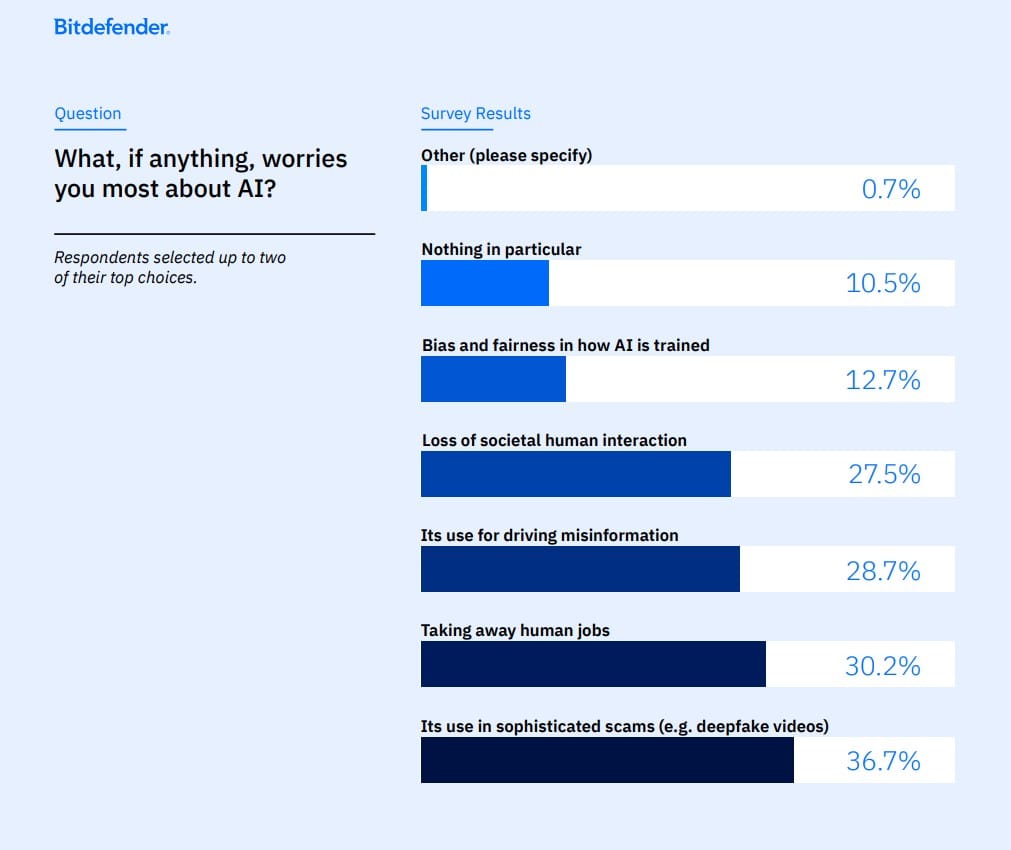
In the 2025 Bitdefender Consumer Cybersecurity Survey, consumers in seven countries stated loud and clear that they are concerned about AI being weaponized to commit fraud and deception.
While AI promises incredible advances, 37% of respondents said the use of AI in sophisticated scams, such as deepfake videos, was their top concern — ranking above job loss and misinformation.
As scams and fraud grow more sophisticated and harder to detect, we strongly advise consumers to adopt a cautious and proactive approach to digital interactions:
- Be wary of urgent or emotionally charged messages, especially if they involve money. Scammers frequently impersonate victims’ family members or colleagues, or authorities, using AI-generated voices or deepfakes to create panic and pressure quick decisions.
- Verify requests through a second channel. If you receive a call or message claiming to be from a loved one or institution, hang up and contact the person or organization directly using a trusted number.
- Limit what you share online. Publicly available photos, videos and voice clips can be used to train AI tools for impersonation scams.
- Use strong, unique passwords and enable multi-factor authentication (MFA) on financial and email accounts to reduce the risk of unauthorized access.
- Be cautious with investment opportunities that promise high or guaranteed returns, particularly those involving cryptocurrencies. These remain among the most common and costly fraud schemes globally.
- Finally, consider using reputable security software and staying informed about emerging scam tactics.
- When in doubt about an unsolicited phone call, text or social media interaction, use Scamio, our free scam detector and prevention service. Simply describe your situation and let Scamio guide you to safety.
With losses nearing $21 billion in the U.S. alone, the latest IC3 report confirms what security experts have warned for years: scams are evolving faster than most people can keep up. The challenge isn’t just awareness. It’s staying one step ahead.
Enter Bitdefender Scam Radar
To help people stay ahead of evolving threats, Bitdefender has recently introduced Scam Radar, a new feature integrated into Bitdefender Mobile Security for Android and Bitdefender Mobile Security for iOS.
Scam Radar enhances our existing mobile security defenses with new capabilities aimed at early threat prevention and improving user awareness. It monitors emerging scam campaigns, including local scams, and alerts you before you become a target.
Unlike traditional protection, which reacts after a threat is detected, Scam Radar focuses on early warning and prevention by monitoring emerging threats.
Learn more at: https://www.bitdefender.com/en-us/blog/hotforsecurity/scam-radar-bitdefender.
You may also want to read:
Easter scam emails to watch out for in 2026
tags
Author

Filip has 17 years of experience in technology journalism. In recent years, he has focused on cybersecurity in his role as a Security Analyst at Bitdefender.
View all postsYou might also like
Bookmarks
