Police Warning: Your bank is not coming to your house for your card

August 13, 2026
Scammers can be frighteningly creative. And while we tend to imagine scams happening behind a phone or laptop screen, they don't always stay there.
Police in Kent, Ohio, are warning the public about a banking scam that can start with a simple text message and end with a stranger showing up at your front door to collect your bank card.
Key takeaways
- Your bank will not send someone to your home to collect a compromised debit or credit card.
- Caller ID isn't proof you're speaking with your bank. Scammers can spoof legitimate phone numbers.
- A scam that starts online can quickly move offline. Never assume you're physically distant from the people behind a text, email or phone scam.
- Don't move or withdraw money because someone claims your account is part of an investigation.
- If someone unexpectedly comes to your home claiming to represent your bank, don't give them your card, PIN, cash or personal information.
- Discuss new scams with your family. Parents, grandparents and other relatives should know about emerging tactics before they're confronted with them.
How does the bank card collection scam work?
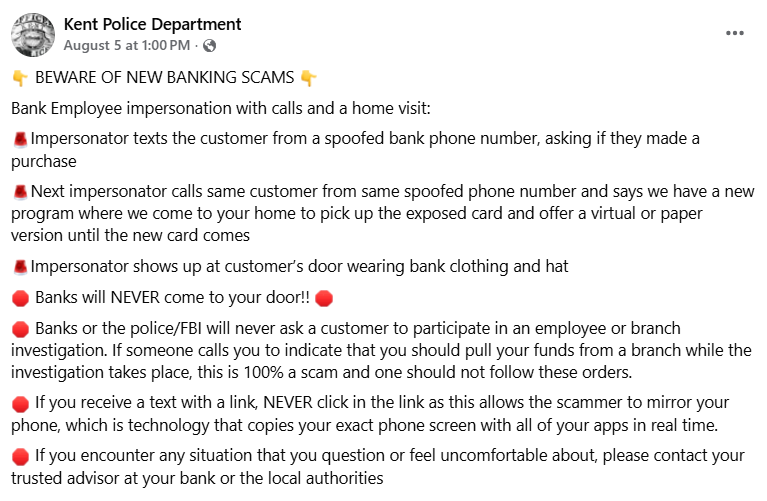
According to Kent Police, the scheme can begin with a text message that looks like it comes from your bank.
The message asks if you recognize a supposedly suspicious transaction. This creates a sense of urgency and gives scammers a reason to contact you again.
Next comes a phone call.
The criminal poses as a bank representative and claims your card has been compromised. Caller ID may even display what appears to be the bank's legitimate phone number.
That doesn't make the call genuine. Caller ID information can be spoofed, allowing scammers to disguise the number they're actually calling from.
Then comes the twist that makes this scam stand out.
The supposed bank employee offers to send someone to your home to collect the compromised card and provide a temporary replacement.
A person posing as a bank employee may subsequently arrive at the address, potentially wearing clothing intended to make the visit look legitimate.
It's a reminder that scammers aren't restricted to phishing emails, text messages or fraudulent websites. If a scheme requires someone to knock on your door to make the deception more believable, some criminals are willing to take that step.
And if this sounds a bit familiar, that’s because it’s not the first time similar tactics have been used to steal people’s money.
If you’re a regular on our Hot for Security blog, you’ve probably read about a similar scheme. For example, in July 2025, we talked about gold-bar scams in which criminals impersonated government or law-enforcement officials and convinced victims to withdraw their savings, buy gold, and hand it to a supposed "courier."
Now, the scale of these schemes is becoming clearer. In August 2026, the NYPD warned that hundreds of victims may have lost more than $100 million to gold-bar scams. In many cases, a courier reportedly showed up at the victim's home to collect the gold while another scammer remained on the phone.
When an online scam follows you into the real world
There's another reason this particular type of scam deserves your attention.
We often think of online scams as having a degree of physical separation. The criminal is somewhere behind a screen, while you're behind yours.
But think about it like this:
If criminals have your name, phone number, and home address, and you engage with their initial messages, they may learn even more about you before someone arrives at your door.
An in-person visit could potentially reveal additional information about your household:
· Who answers the door?
· Does an older person live alone?
· Are there other family members around?
· What security measures are visible?
· Is there a doorbell camera?
· Does the person appear particularly trusting or vulnerable?
There is no indication from the Kent Police warning that this scheme has led to burglaries or home invasions. Still, allowing someone involved in a scam to visit your home creates a physical-security concern that doesn't exist with an ordinary phishing email.
And there's a broader issue worth considering. If criminals know that someone has already responded to one scam, what's stopping them from trying again?
Scam victims can be targeted repeatedly, sometimes through completely different approaches. That's one more reason to treat an incident like this as more than a compromised bank card.
And let’s break down the part that makes this type of scam so convincing.
First of all, these fraudsters don’t rely on a single trick to con people. They build credibility in multiple stages, using text messages to alert you, a phone call to confirm the “issue,” and personal information to establish trust.
Then comes the solution to fix your problem: another person physically arriving at your door.
Each step appears to confirm the one before it.
That's also why an unexpected call shouldn't be trusted simply because the caller knows something about you. Names, addresses, phone numbers, email addresses and other personal information can be obtained through data breaches, public records, social media, previous scams and other sources.
And remember, knowing your name, bank or address doesn't prove someone is legitimate. Sometimes it simply means a scammer has done their homework.
Will a bank come to your house to collect a compromised card?
Definitely Not! A request to hand a payment card to someone arriving at your home should immediately raise alarm bells.
If your card really has been compromised, stop communicating with the person who contacted you and independently contact your bank.
Use the official banking app, visit a branch, or call the verified telephone number printed on your card or published on the bank's official website.
Don't use a phone number or link supplied in the suspicious text message.
Police also warn that legitimate banks and law enforcement agencies won't tell you to withdraw or move money because it's supposedly needed for an investigation.
Requests to transfer your savings to a "safe account," withdraw cash for safekeeping, hand over a bank card, or give someone your PIN are also major warning signs.
What if someone claiming to be from your bank comes to your door?
Don't hand over your card, cash, PIN, account credentials or identification documents.
Remember, you don't have to continue the conversation simply because someone is standing at your door.
Don't let the visitor inside. Close the door and contact your bank independently. If the person refuses to leave, behaves aggressively or makes you feel unsafe, contact local law enforcement.
Uniforms, badges, branded clothing and caller ID can all be used to create an appearance of legitimacy. Verification should happen through a communication channel you choose, not one provided by the person asking for your money or card.
What should you do if you receive a suspicious bank text?
If you receive an unexpected fraud alert, don't panic. A few simple steps can help you determine whether there's actually a problem:
- Don't click links in the message. Open your banking app yourself or type the bank's official website into your browser.
- Don't continue an unexpected call. Hang up and contact the bank using a verified number.
- Never reveal your PIN, password or verification codes.
- Don't move money to protect it. Anyone urgently instructing you to transfer or withdraw your savings because your account is supposedly under attack should be treated with suspicion.
- Never hand your card to an unexpected visitor.
- Check your account. Look for transactions, transfers or changes you don't recognize.
You can also check suspicious messages with Bitdefender Scamio and inspect questionable URLs with Bitdefender Link Checker before interacting with them.
Make scam awareness a family conversation
There's one security resource every family already has: each other.
Don't wait until a parent or grandparent receives a suspicious phone call to explain how these scams work. Talk about new tactics when you hear about them.
Consider making scam awareness a small monthly family habit. It doesn't need to be a cybersecurity lecture. Spend ten minutes talking about one or two scams you've recently encountered or read about. Show parents and grandparents examples of suspicious texts. Remind everyone that caller ID can be spoofed and that legitimate organizations won't pressure them into immediately handing over money, cards or passwords.
Most importantly, agree on a simple family rule: If something feels strange, urgent or frightening, call someone you trust before doing anything.
That conversation becomes even more important as scammers combine digital and real-world tactics. Protecting a family today isn't just about securing individual devices. It's about protecting the accounts, identities, money and personal information connected to everyone in the household.
Bitdefender's family plans are designed around that broader idea of protecting your entire digital life across the people and devices that matter to you. Combined with regular conversations about scams, technology can provide another layer of protection when fraudulent messages, malicious links and other threats reach family members.
Already handed over your card? Act quickly
If you've given your card, PIN or banking information to someone you now suspect is a scammer, contact your bank immediately.
Ask the bank to block the card and review the account for unauthorized transactions. Change compromised online-banking credentials and check whether unfamiliar beneficiaries, transfers or contact details have been added.
If you've shared passwords that you also use elsewhere, change those accounts too and use unique passwords going forward.
Report the incident to local law enforcement and preserve text messages, phone numbers, screenshots, transaction records and any available doorbell or security-camera footage.
Because the scammers may now have your home address and know that someone at the address responded to their scheme, make sure everyone in the home knows what happened. Be particularly cautious about unexpected visitors, calls or follow-up messages.
FAQs
Would a scammer come to your house?
Yes. While many scams happen entirely through calls, texts, emails or websites, some schemes involve in-person couriers or scammers coming directly to a victim's home.
The FBI has warned about scams in which criminals impersonating government agencies, banks or tech-support companies convince victims to withdraw cash or buy gold before sending a courier to collect it.
Can someone steal your money if they have your bank details?
It depends on what information they have. Knowing your bank's name or even some account information doesn't necessarily give a scammer direct access to your money, but those details can help them build a much more convincing attack.
However, if a scammer has your bank account number and routing number, they may attempt unauthorized withdrawals or payments from your account.
Additionally, scammers may use information they already have to impersonate your bank and trick you into revealing passwords, card information, PINs or one-time verification codes. They may also persuade you to authorize a transfer yourself.
If you believe your banking information has been compromised, contact your bank immediately using its official app, website or the number printed on your card.
Should I be worried if a scammer has my address?
Don't panic, but take it seriously. Your home address alone usually isn't enough for someone to access your bank account, but scammers can combine it with other personal information to make future scams much more convincing.
Your address can also be used for scams that reach your physical doorstep. In so-called brushing scams, for example, criminals or unscrupulous sellers send packages you never ordered to your home. More recently, the FBI and FTC have warned about a variation involving unsolicited packages containing QR codes. The recipient may be encouraged to scan the code to discover who sent the "gift" or how to return it, only to be directed to a phishing site designed to steal personal or financial information or potentially download malicious software.
Receiving a strange package doesn't necessarily mean you're in immediate physical danger. But it does show why you shouldn't dismiss the fact that a scammer has your address. Be alert for follow-up calls and messages, unexpected packages and people showing up at your door, and make sure everyone in your household knows what's happening.
And never scan a QR code in an unsolicited package simply because you're curious about who sent it.
tags
Author

Alina is a history buff passionate about cybersecurity and anything sci-fi, advocating Bitdefender technologies and solutions. She spends most of her time between her two feline friends and traveling.
View all postsYou might also like
Bookmarks
