Tax Identity Theft: How It Occurs and How to Prevent It

November 09, 2026

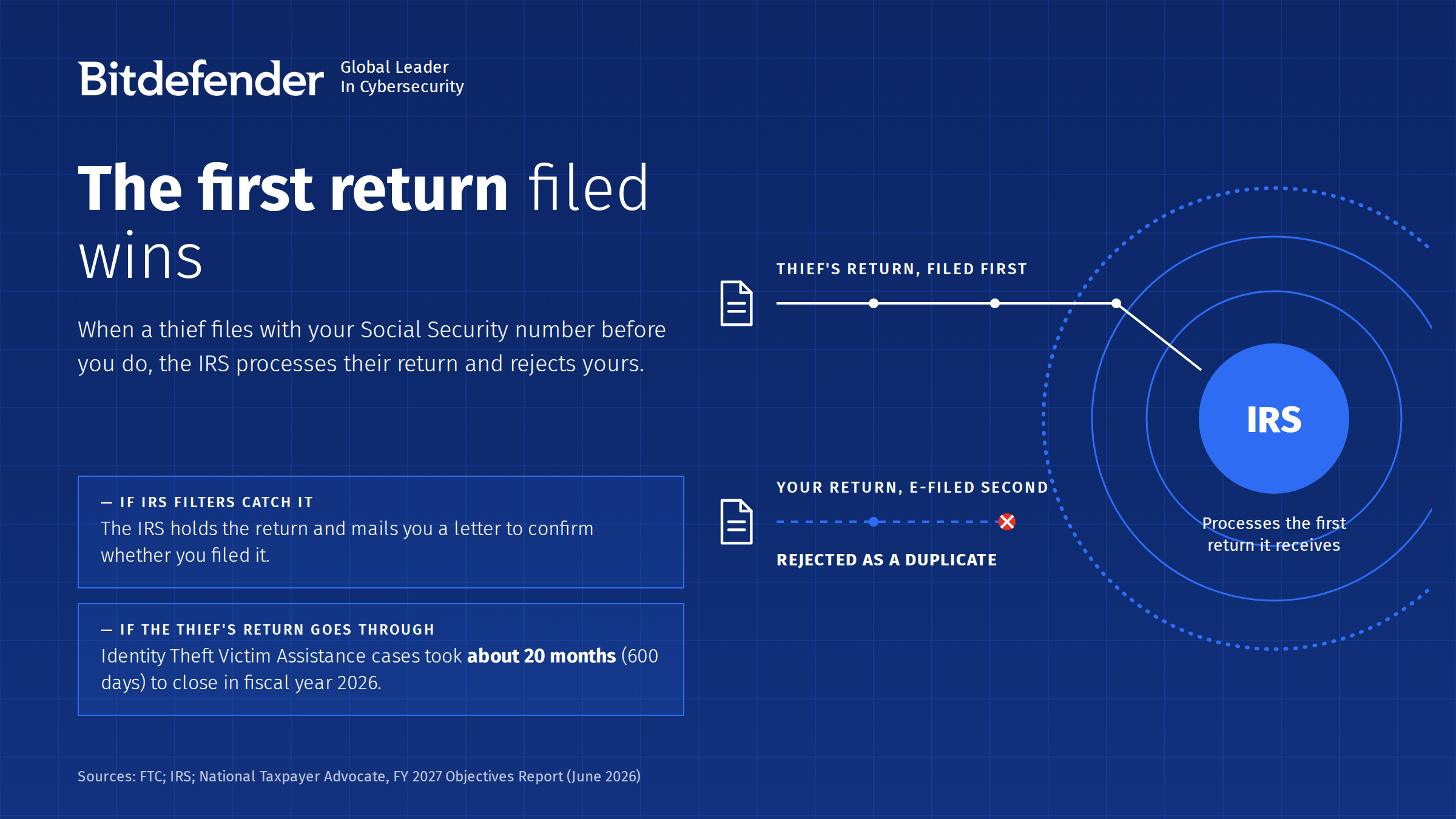
Tax identity theft works like a race, and the prize is your tax refund. When someone files a tax return with your Social Security number before you do, the Internal Revenue Service processes their return first and rejects yours as a duplicate. In that scenario, the first sign arrives at that moment, when the return you file is turned away.
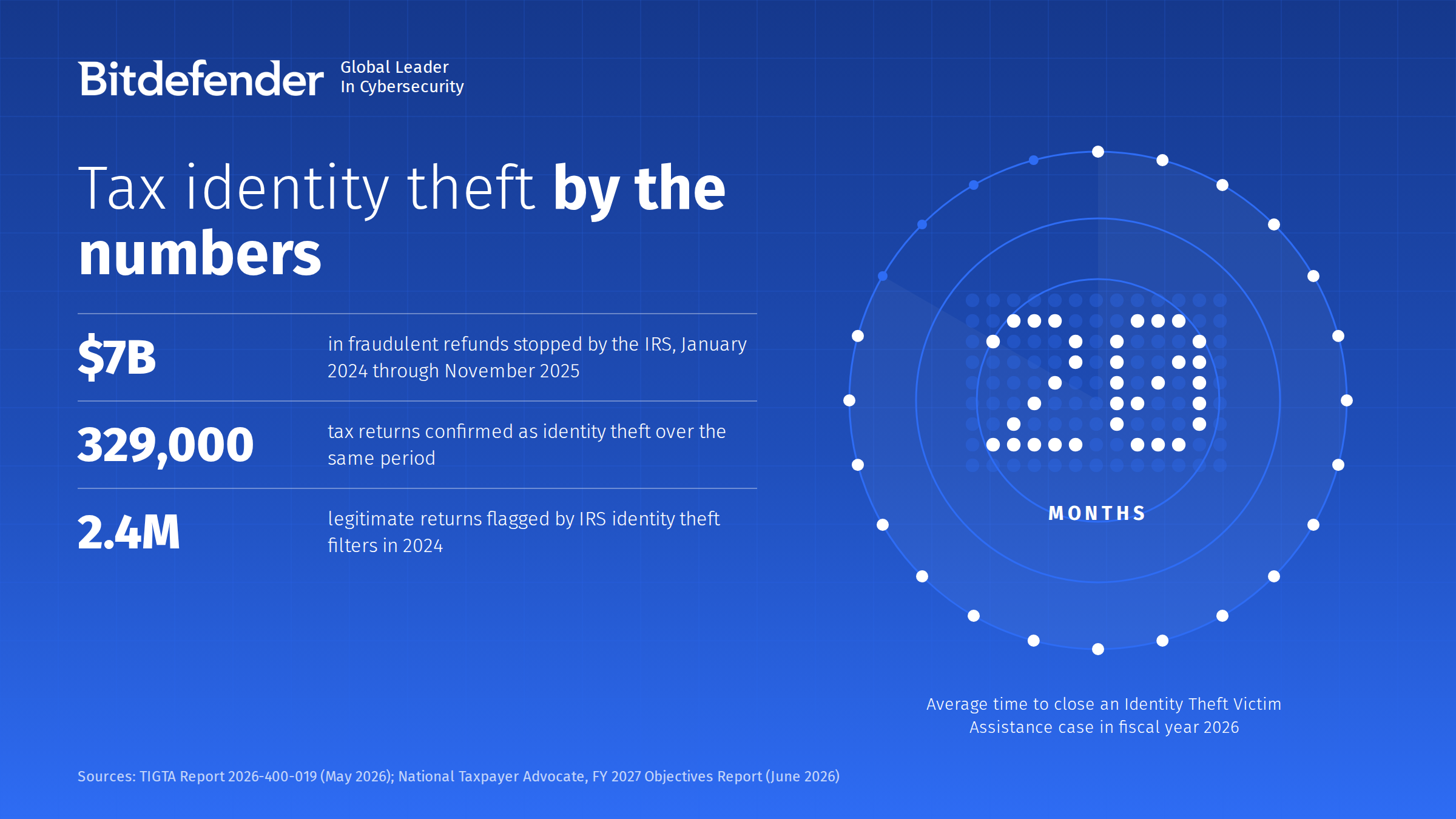
How long recovery takes depends on which return the IRS processes first. If its filters catch the fraudulent return, the IRS holds it and sends a letter asking you to confirm whether you filed it. If the thief's return goes through, your case moves to the IRS Identity Theft Victim Assistance Unit, where cases took about 20 months to resolve during the 2026 filing season, with the refund on hold until the case closes. The IRS fights back at scale, stopping $7 billion in fraudulent refunds across 2024 and 2025, yet each case that slips through lands on a real taxpayer.
Because the IRS accepts the first return filed under your SSN, this guide focuses on that route. It explains what tax identity theft is, how thieves get ahead of you, the warning signs that someone filed first, and the steps that keep you in front or help you recover.
Key Takeaways
- Tax identity theft uses your Social Security number to file a fraudulent return. Criminals use it to claim a refund, get a job, or claim your child as a dependent.
- The first return filed wins. The IRS rejects the second e-filed return with the same SSN, so filing early shrinks the thief's window, and an Identity Protection PIN blocks e-filed returns made without it.
- IRS letters, rejected e-files, and unfamiliar tax documents are the warning signs. Respond through the official channels listed in the letter and on IRS.gov.
- Recovery takes time, but prevention takes minutes. A free IP PIN, two-factor authentication, and a careful choice of tax preparer protect you before tax season starts.
What Is Tax Identity Theft?
Tax identity theft occurs when someone uses your Social Security number and personal information to steal your tax refund or to get employment. Identity thieves file a tax return in your name, claim a fraudulent refund, and direct it to an account they control.
Tax-related identity theft differs from broader identity theft in where the damage lands. A thief who opens a credit card in your name harms your credit report, while a thief who files taxes in your name creates a record at the IRS that you then have to correct. That record affects your refund, your income history, and your future tax filings, which is why the recovery runs through the IRS.
The IRS confirmed 329,000 tax returns as identity theft across 2024 and 2025, and the damage reaches beyond refunds when a thief uses your SSN to get a job.
How Does Tax Identity Theft Occur?
Tax identity theft occurs in two stages. First, identity thieves collect your personal information, and then they use it during tax season, when the IRS processes nearly 139 million individual returns.
How thieves get your information
Scammers impersonate the IRS to steal the data they need. The IRS lists impersonation by email and text message, along with phone calls that use AI voice mimicry and spoofed caller ID, among its 2026 Dirty Dozen tax scams. These messages push you to click links to a fake IRS page, confirm your Social Security number, or "verify" your bank account. AI has made these calls harder to spot, since AI voice tools help scammers sound natural and authoritative.
Other routes include data breaches that expose your SSN, stolen mail containing tax documents, and dishonest tax preparers who misuse the information you give them.
How thieves use your information
Once identity thieves have your Social Security number, they use it in three ways:
- Fraudulent refund claims. The thief files a tax return in your name early in tax season and redirects the refund money to accounts or addresses they control. In a case federal prosecutors announced in October 2026, a group allegedly used hundreds of stolen identities to seek over $100 million in refunds, directing the IRS to split them across prepaid debit cards shipped to addresses the group controlled.
- Employment fraud. Someone uses your SSN to get a job, and the employer reports their wages to the IRS under your number.
- Dependent fraud. Someone claims your child as a dependent to collect credits, using your child's Social Security number on their own return.
Protect Personal Information and Your Social Security Number
The steps that prevent tax identity theft are free, and each one closes a route described above.
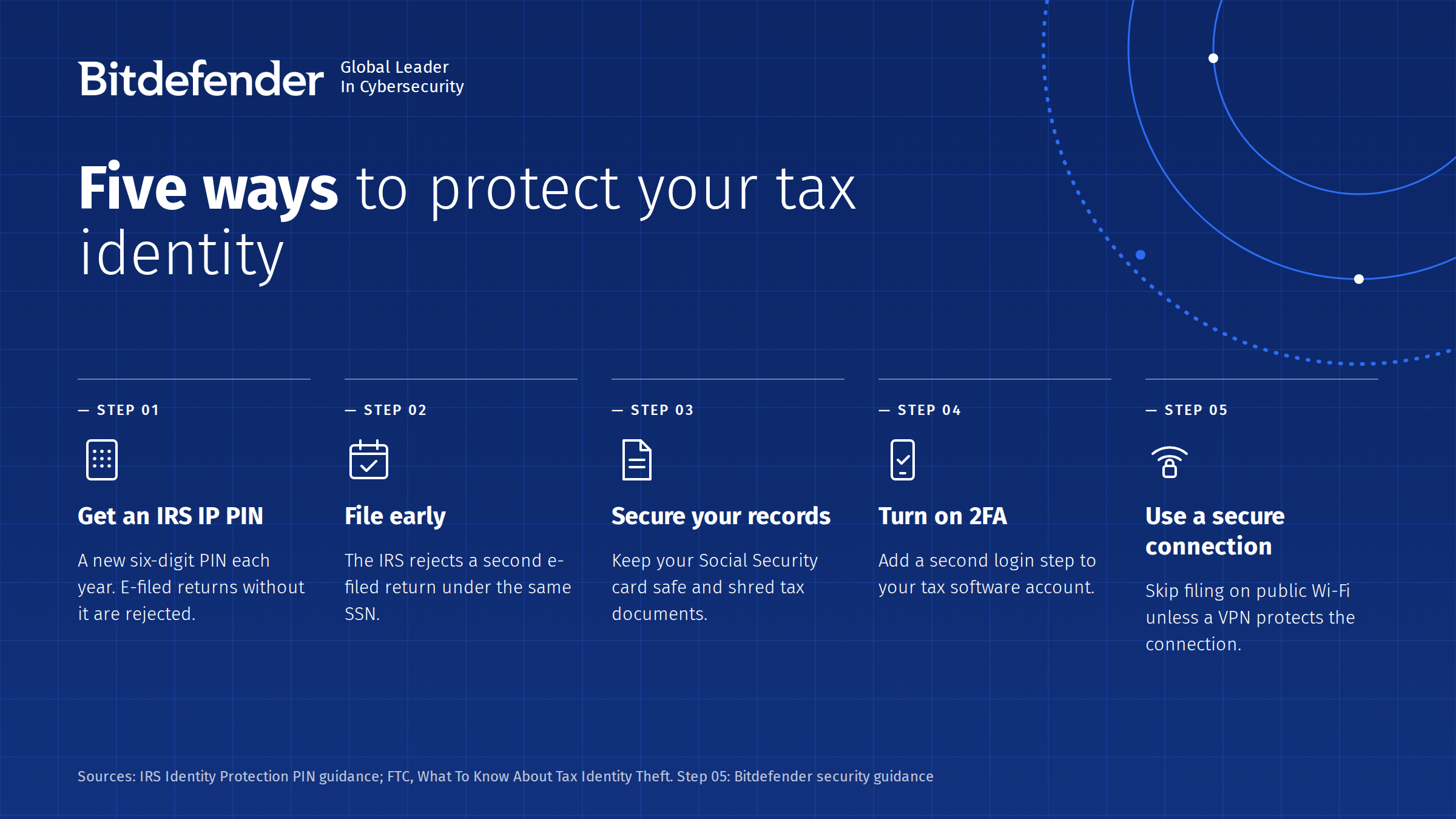
- Get an IRS Identity Protection PIN. An IP PIN is a six-digit number that protects your SSN on federal tax returns, and anyone with an SSN can request one at no cost. The IRS issues a new one each year, so an e-filed return with your SSN and a missing or wrong IP PIN is rejected, and a paper return is held until the IRS verifies who filed it.
- File your tax return early. Because the IRS accepts the first return filed with your SSN, filing as soon as you receive all your tax statements reduces the window in which a thief can file first.
- Secure your tax records. Keep your Social Security card and tax documents in a safe place at home, and shred tax records before you throw them away. Drop a paper return at the post office to keep it out of an unsecured mailbox.
- Turn on two-factor authentication. Use two-factor authentication for your tax preparation software account and your IRS online account, so a stolen password alone does not give anyone access.
- File taxes over a secure internet connection. Avoid filing electronically or opening your IRS account over public Wi-Fi without a VPN, since the connection carries your SSN and bank details.
Choose a Trustworthy Tax Preparer
A tax preparer sees everything a thief needs, which makes your choice of preparer part of your identity protection. Every paid preparer must have a valid Preparer Tax Identification Number (PTIN) and must sign every return they prepare.
Before you hire a tax preparer or tax advisor, verify these points:
- Credentials. Search the IRS Directory of Federal Tax Return Preparers to check the person's credentials and qualifications.
- Signature and PTIN. A preparer who refuses to sign the return is a "ghost preparer." TIGTA found that 84% of preparers linked to one refund scheme across tax years 2023 and 2024 held no credentials, and ghost preparers filed returns in the same scheme claiming about $179 million in refunds.
- Refund promises. Be wary of any preparer who claims they can get you a larger refund than their competitors.
- The return itself. Review the full return before you sign, never sign a blank or incomplete form, and make sure the refund goes to your own bank account.
If a preparer files or changes your return without your consent, the IRS asks you to submit Form 14157-A, the Tax Return Preparer Fraud or Misconduct Affidavit.
Recognize IRS Notices and Other Warning Signs
Victims become aware of tax identity theft through a letter or a rejected e-file from the IRS, or through their own records, as the next section shows. The IRS, the federal agency that processes your return, makes most first contacts by mail. Its employees may call or visit in some cases, such as audits or collection, and private collection agencies contact you only after written notice. The IRS does not initiate contact by email, text message, or social media to request personal or financial information.
Watch for these warning signs:
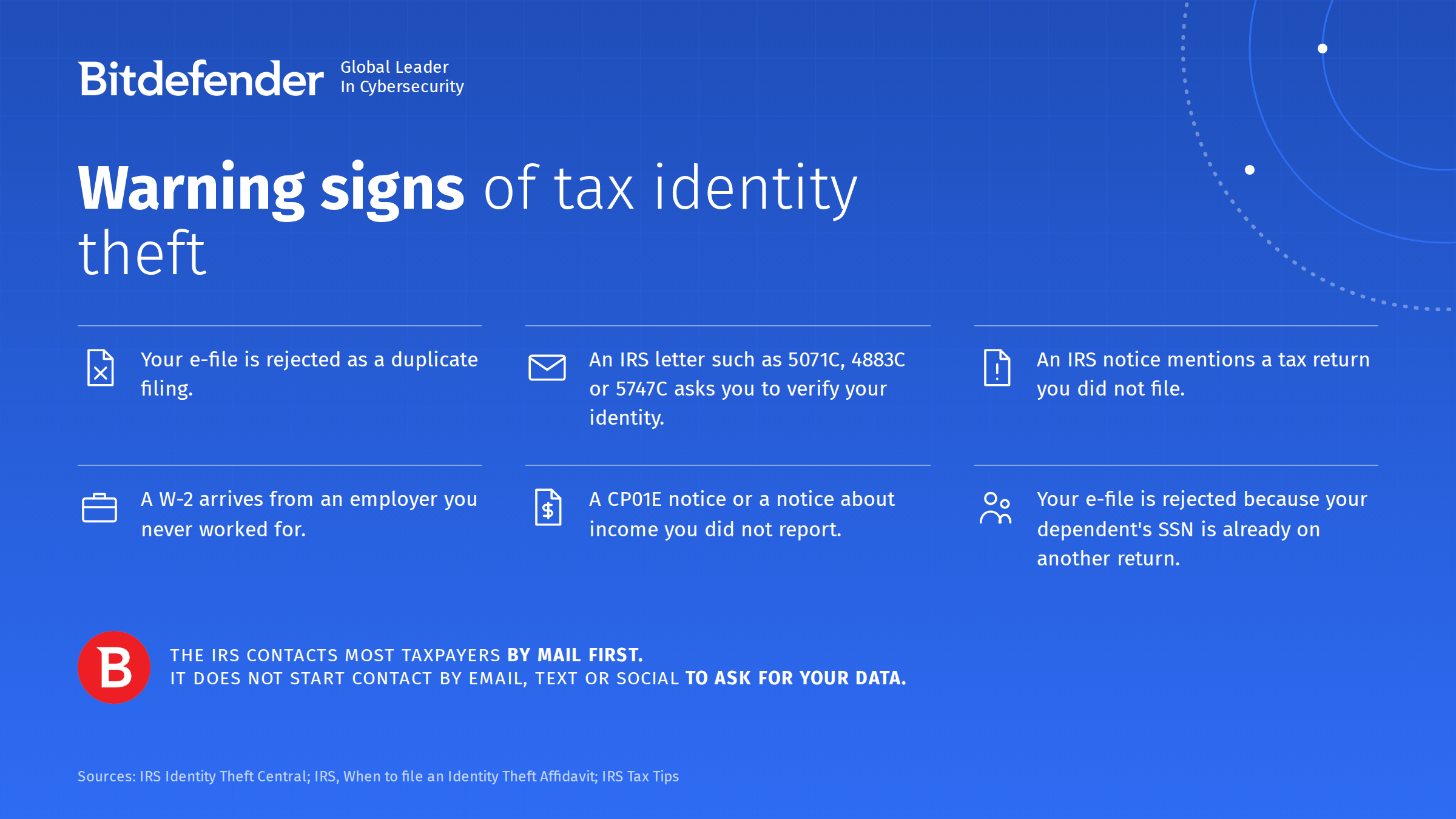
- The IRS rejects your e-file as a duplicate filing. This means another return with your SSN already exists in IRS records, since the IRS does not accept a second e-filed return under the same number.
- An IRS letter asks you to verify your identity. Letters such as 5071C, 4883C, and 5747C mean the IRS needs to confirm that you filed a return it received under your name, and someone may have used your SSN. Follow the instructions in the letter, and confirm the letter is genuine through IRS.gov before you share any information.
- An IRS notice mentions a suspicious tax return you did not file. Any letter about a tax return, refund, or tax year you do not recognize deserves a prompt response.
An identity verification letter can also reach a legitimate filer. The IRS filters flagged 2.4 million legitimate returns in 2024, about 1.4% of all returns filed, and once those taxpayers verified their identity, the IRS posted their returns within 13 days on average. The volume stayed high in 2026, when the IRS line for verifying identity on suspended returns received about 2.4 million calls.
Watch for Tax Return and Tax Refund Problems
Some signs of tax identity theft appear in your own tax records. These signal that someone is using your SSN for work or to claim benefits:
- A W-2 from an employer you never worked for. It means someone is earning wages under your Social Security number.
- A notice about income you did not report. When an employer reports a thief's wages under your SSN, IRS records show income you never received. A CP01E notice tells you the IRS detected this kind of employment-related identity theft, and it has no known impact on your tax return.
- A rejected claim for your child. If your e-file is rejected because your dependent's SSN already appears on another return, someone may have claimed your child. The IRS automatically identifies dependents claimed on more than one return, and a claim by someone you do not know may be identity theft. If the SSN is correct and the primary taxpayer on your return holds a current-year IP PIN, you can still e-file your return, and otherwise, you file it on paper.
- Unfamiliar earnings on your Social Security record. Check your earnings history in a my Social Security account each year, since wages reported under your SSN appear there.
To stop someone from using your SSN to get a job with an employer that uses E-Verify, you can lock your number through a free myE-Verify account.
What To Do After Tax Identity Theft
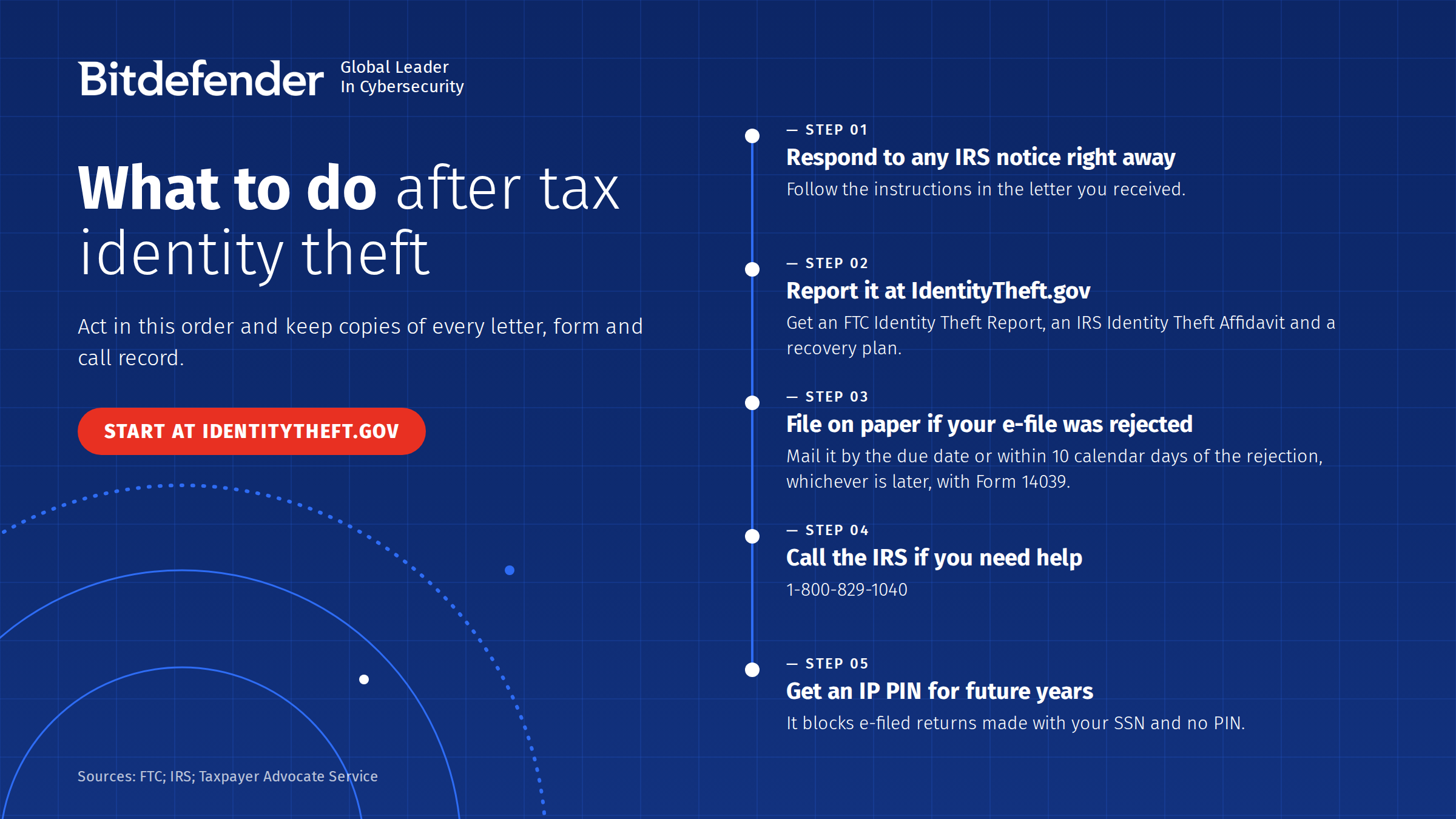
If you are a victim of tax identity theft, act in this order and keep copies of every letter, form, and call record:
- Respond to any IRS notice right away. Follow the instructions in the letter you received, which may ask you to verify your identity online or by phone.
- Report it at IdentityTheft.gov. The Federal Trade Commission site creates your FTC Identity Theft Report, an IRS Identity Theft Affidavit, and a personal recovery plan, and it can submit the affidavit to the IRS online.
- File your tax return on paper if your e-file was rejected. Mail the paper return within 10 calendar days of the rejection, with your identity theft affidavit attached, and pay any taxes you owe on time.
- Contact the IRS if you need help. Call the IRS at 1-800-829-1040, and contact the Taxpayer Advocate Service if your case causes financial hardship.
- Get an IP PIN for future years. It prevents the same thief from e-filing with your SSN again, and the IRS assigns one each year to taxpayers it confirms as victims.
Submit an IRS Identity Theft Affidavit
The IRS identity theft affidavit, Form 14039, tells the IRS that someone used your information for tax fraud. The IRS lists the situations in which you submit it:
- Your e-file was rejected because a return with your SSN was already filed, in which case you attach the form to your paper return.
- Your e-file was rejected because someone used your dependent's SSN without your knowledge or permission.
- You received a tax transcript you did not request.
- Your tax software company confirmed an account was created, accessed, or disabled in your name without your action.
- An IRS notice says you owe additional tax, had a refund offset, or faced collection action for a year you did not file.
- An IRS notice says you received wages from an employer you did not work for.
You do not need Form 14039 if you received Letter 5071C, 4883C, or 5747C. In that case, you follow the instructions in the letter. You can submit the form through IdentityTheft.gov, online through the IRS, or by mail or fax, and the IRS identity theft guide lists the option that fits your case.
Monitor Your Credit Report After Tax Identity Theft
A thief who files taxes with your SSN can use the same data to open financial accounts or take out a loan in your name. Your credit report shows those accounts, so checking it after tax identity theft helps you catch the next stage of the fraud early.
- Check your credit reports. Equifax, Experian, and TransUnion each offer free weekly reports at AnnualCreditReport.com. Look for accounts, inquiries, addresses, and other suspicious activity you do not recognize.
- Place a fraud alert. Contact one credit bureau, which must notify the other two, so lenders verify your identity before opening new credit.
- Consider a credit freeze. A freeze blocks new credit accounts until you lift it, and you place it separately at each bureau.
- Use credit monitoring. Credit monitoring alerts you to new accounts and inquiries as they happen, which shortens the time between fraud and discovery.
Strengthen Tax Identity Protection With Secure Technology
Tax identity theft depends on two things: access to your sensitive information and a message convincing enough to make you act on it, and technology helps on both sides.
On the prevention side, Bitdefender Ultimate Security includes Scam Protection Pro, which flags phishing emails, text messages, and links, including those impersonating government agencies. Its VPN gives you a secure internet connection when you file or check your refund on public Wi-Fi, and its dark web monitoring alerts you when your personal information appears in a data breach.
On the detection side, Ultimate Security Plus adds Bitdefender Identity Theft Protection for US customers with a valid SSN. Its Smart SSN Tracker alerts you to the names, aliases, and addresses associated with your SSN, and Advanced Fraud Monitoring notifies you when your identity is used to apply for credit or a loan. If fraud occurs, identity theft insurance and a resolution specialist help you through recovery.
The IRS steps remain yours to take. Request your IP PIN, file early, and respond to IRS notices through IRS.gov, while Bitdefender watches for the scams and identity misuse that come before and after a fraudulent return.
Frequently Asked Questions
What is tax identity theft?
Tax identity theft is the use of your Social Security number and personal information to file a fraudulent tax return, claim your refund, get a job, or claim your dependents.
How can tax identity theft occur?
It occurs when identity thieves get your SSN through IRS impersonation scams, data breaches, stolen mail, or a dishonest tax preparer, then file a tax return in your name before you do.
How do I know if I am a victim of tax identity theft?
Common signs are an e-file rejected as a duplicate filing, an IRS letter asking you to verify your identity, a W-2 from an employer you never worked for, or a notice about income you did not earn.
Does the IRS contact you by email or text?
The IRS does not initiate contact by email, text message, or social media to request personal or financial information. It makes most first contacts by mail, so treat unexpected tax messages as suspicious.
How long does it take to resolve tax identity theft?
It depends on the case. When IRS filters flag your own legitimate return, the IRS posted it within 13 days on average after you verified your identity. When a fraudulent return was already processed, identity theft victim assistance cases took about 20 months to resolve during the 2026 filing season, and the refund stays on hold until the case closes.
tags
Author

The meaning of Bitdefender’s mascot, the Dacian Draco, a symbol that depicts a mythical animal with a wolf’s head and a dragon’s body, is “to watch” and to “guard with a sharp eye.”
View all postsYou might also like
Bookmarks
