SpaceX wants customer data from failed startups as AI fodder

September 18, 2026

SpaceX has reportedly discussed buying customer and operational data from failed startups to help train AI models, highlighting an uncomfortable reality: while a company may disappear, the information it collected may linger.
Key takeaways
- SpaceX has reportedly discussed buying customer and operational data from troubled or defunct startups for AI training
- The discussions are informal, and there is no indication yet that a purchase will take place
- Corporate data left behind when businesses fail is increasingly valuable to AI developers
- Bitdefender research shows consumers are wary about how technology companies handle their information
- Consumers should assume that information shared with an online service could survive long after they stop using it
You may stop using an app. The startup behind it may run out of money. Its website may disappear altogether. But the information you handed over doesn't necessarily disappear with it.
Elon Musk's SpaceX has held internal discussions about buying customer and operational information from struggling or defunct startups as a relatively inexpensive source of data for AI training, according to Bloomberg.
The discussions are reportedly informal and may never result in an acquisition. But the idea illustrates a much bigger privacy issue as technology companies race to obtain the enormous quantities of real-world information needed to develop increasingly capable AI systems.
Failed companies can leave valuable data behind
According to Bloomberg, teams within SpaceXAI have considered acquiring data from companies that are struggling financially or have gone out of business.
Modern AI models need enormous quantities of information, and the public web isn’t the only place with valuable datasets.
A failed business may leave behind years of customer interactions, internal communications, documents and operational records – information that could give AI developers specialized, real-world material that is difficult or expensive to obtain elsewhere.
SpaceXAI also uses information from Musk's other companies. The billionaire recently told SpaceX employees that Grok would be trained on the company's information, reportedly telling workers: "It'll be trained on you."
The prospect of acquiring datasets from failed companies raises a related question for ordinary internet users: Did you agree to your information being used this way when you originally handed it over?
A privacy policy accepted years ago may not have prompted users to imagine that the company could eventually collapse and its remaining information become a valuable asset in an AI data market.
Google has already gone shopping for corporate data
SpaceX wouldn’t be the first to do it either.
Google recently won a bankruptcy auction for a large collection of data belonging to collapsed Spirit Airlines, offering $10 million for information it plans to use to improve its products and AI models. The proposed acquisition includes roughly 100 million emails and 500 million Microsoft Teams chats, alongside documents, spreadsheets and other corporate information.
Passenger profiles and frequent-flyer information are excluded. Google has also said that the information it receives will be scrubbed of personally identifiable information by a third party and that it won't try to re-identify individuals.
Still, the proposal has generated pushback.
The Association of Flight Attendants raised concerns about potentially sensitive employee information contained in the dataset, including internal communications, payroll history and disciplinary records. The union argued that de-identification may not eliminate all privacy implications for former workers.
The SpaceX discussions suggest this could become a broader phenomenon. If specialized corporate datasets prove useful in training AI, information held by companies in financial distress may become more valuable.
Consumers already have trust issues with Big Tech
That prospect lands as consumers are conflicted about trusting major technology companies with their information.
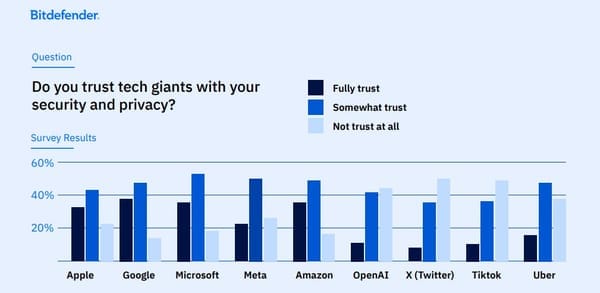
Bitdefender’s 2025 Consumer Cybersecurity Survey, covering more than 7,000 internet users across seven countries, finds a striking divide.
Established technology companies enjoy comparatively high levels of trust: 88% of respondents say they trust Google to some extent, 85% say the same of Microsoft and 77% trust Apple.
But attitudes toward social platforms and newer AI companies are considerably more skeptical. 52% say they don't trust X/Twitter at all, 51% say the same of TikTok, and 45% express distrust toward OpenAI.
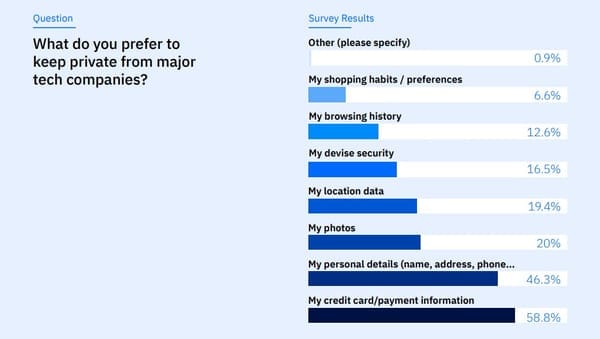
And consumers draw particularly strong boundaries around the information they consider sensitive. 59% want to keep credit card and payment information private from major technology companies, while 46% say the same about personal details.
The reported SpaceX discussions highlight why trust increasingly depends on more than whether a company protects your information from hackers.
Consumers have to consider what a company itself can do with their data – as well as what might happen if that company is acquired, goes bankrupt or simply disappears.
Your account can disappear. Your data might not
When people hand information to a service, they tend to think about the company as it exists today. But companies change ownership. They merge. They sell assets. They rewrite privacy policies. And sometimes they fail. That can create a mismatch between the context in which information was originally provided and the purpose for which it might eventually be used.
There may be little consumers can do once a company enters bankruptcy and its assets are being disposed of. But the emerging market for AI training data makes good privacy habits even more important:
- Share only the information a service genuinely needs
- Delete unused accounts where possible
- Review privacy and data-retention options before uploading sensitive material
- Think carefully before storing highly personal information with a service simply because it is convenient
- Consider using a data monitoring service like Bitdefender Digital Identity Protection
- Use a trusted security solution on your personal devices
On topic:
Which Big Tech companies do you trust? We asked netizens
Big Tech calls for cyber-defense before AI attacks surge
Elon Musk’s X appeals €120 million EU fine under Digital Services Act
tags
Author

Filip has 17 years of experience in technology journalism. In recent years, he has focused on cybersecurity in his role as a Security Analyst at Bitdefender.
View all postsYou might also like
Bookmarks
