Singapore Tells Apple and Google to Block Fake Messages in Crackdown on Scams

December 02, 2025
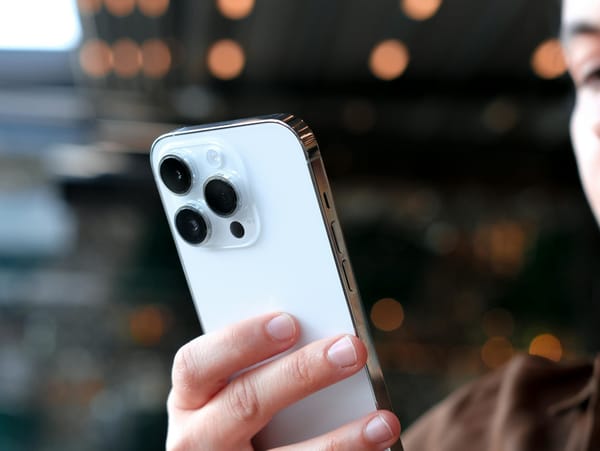
Singapore’s Ministry of Home Affairs (MHA) has issued directives under the Online Criminal Harms Act (OCHA) requiring Apple and Google to implement anti-spoofing measures.
Scammers have found a loophole. While traditional SMS messages from government agencies in Singapore are protected by a verified “gov.sg” sender-ID (as enforced via the SMS Sender ID Registry), this safeguard does not cover messaging platforms such as iMessage or Google Messages.
“To protect the public from impersonation scams, Government agencies have been using the ‘gov.sg’ SMS sender ID to send SMSes since July 2024 to help the public identify legitimate government SMSes easily,” according to the announcement. “While we have imposed this and other safeguards like the SMS Sender ID Registry (SSIR) on SMSes, they currently do not apply to messages sent via iMessage and Google Messages.”
This means criminals can impersonate trusted agencies, including postal services, by simply spoofing the sender name. The result: more than 120 recorded impersonation scams, involving at least ione agency, on those platforms.
Under the new rules, Apple and Google must ensure those apps block – or alt least filter – sender names using gov.sg or names of other government agencies. At the same time, the profile names of unknown senders should be hidden or shown less prominently than their phone number, so users can better spot suspicious messages.
Both companies have indicated they will comply. Users have meanwhile been urged to keep their messaging apps updated to benefit from the latest protections.
A big tech name doesn’t guarantee safety
The move by Singapore’s MHA comes as digital deception is exploding globally. According to our latest Consumer Cybersecurity Survey, which polled over 7,000 internet users worldwide, scams are now a regular part of online life.
Over 70% of respondents reported encountering some form of scam in the past year, and 1 in 7 said they had fallen victim to at least one scam.
Even more concerning is how these scams have evolved. Our survey spotlights AI’s role in enabling ever-more convincing fraud – from deepfake voices and hyper-realistic phishing messages to other types of AI-enhanced social engineering. In fact, 37% of participants in our study cited “creation of sophisticated scams (deepfakes, voice clones, etc.)” as their top concern when it comes to AI.
Yet in parallel to this growing risk, people’s trust in major tech companies remains surprisingly high – even if flawed. When asked about their trust in Big Tech names, participants named Google (trusted by 88% of respondents), followed by Microsoft (85%), and Apple (77%).
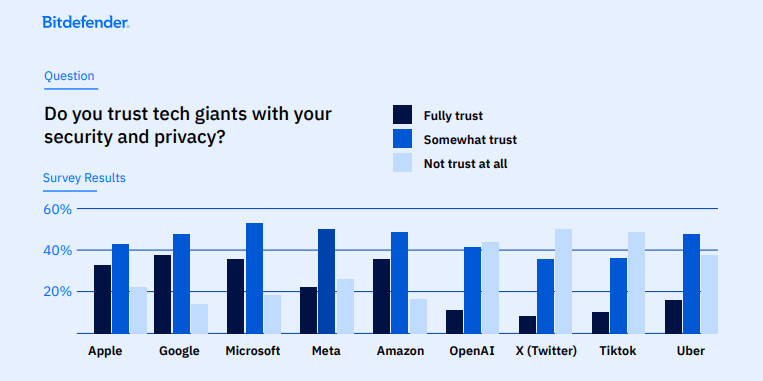
Consumer trust in big names in the tech industry
Source: Bitdefender 2025 Consumer Cybersecurity Survey
That trust likely explains why many users rely on their phones – often without additional protection.
Our study calls this the “phone problem,” where a majority of people say they carry out transactions mainly on their phones, yet nearly as many don’t use an independent mobile security solution.
This reflects a dangerous paradox: users trust big tech to keep them safe, yet their habits – accepting all cookies, reusing passwords, skipping security apps – make them easy targets for next-gen scams, whether via social media, email, or now, spoofed messaging.
Why Singapore’s move is important
The decision by Singapore’s police and legislature shows how crucial trust and authenticity have become.
People who believe they are dealing with a legitimate organization – because it says “Apple” or “Google” – can be deceived if they rely solely on superficial cues like a friendly sender name or an official-looking badge.
Singapore’s action reinforces the core message that platform-level protections are vital. However, the human element (user behavior, awareness) also remains important.
What consumers should do to stay ahead
- Keep your apps updated. Big Tech companies whose services are used by billions release timely security patches and anti-spoofing features. Keep your phone’s OS and messaging apps updated!
- Be suspicious of unexpected messages – even if they look official. If you receive a message claiming to come from a government agency or other official entity, verify via independent channels. Don’t assume legitimacy because of a sender name or logo.
- Use a dedicated security solution on all your devices – especially your phone. Our survey shows that many skip this. A trusted security app can detect malicious links, phishing attempts, suspicious attachments, and even scammers trying to socially engineer you.
- Adopt stronger habits. Use unique, strong passwords (ideally via a password manager), and avoid “accept all cookies” impulses to reduce the chances of having your personal data leaked. Small measures still offer big protection.
- Assume that scams evolve – and stay alert. As our survey warns, AI-driven scams are now mainstream. That means extra caution on social media, messaging apps, and any platform where you interact with unknown senders.
You may also want to read:
1 in 7 Consumers Got Scammed in the Past Year – Bitdefender Consumer Cybersecurity Survey 2025
UK Cracks Down on Scammers Spoofing Your Phone Number
FBI: Scammers Are Posing as Your Bank – Here’s How to Protect Your Account
tags
Author

Filip has 17 years of experience in technology journalism. In recent years, he has focused on cybersecurity in his role as a Security Analyst at Bitdefender.
View all postsYou might also like
Bookmarks
