Instagram giveaway scams are designed to steal your account

March 04, 2026
Instagram scams don’t operate alone – they’re part of the broader ecosystem of impersonation, phishing and account takeover tactics we explore in our in-depth guide to Instagram scams. Fake giveaways and contest schemes are among the most effective entry points in that ecosystem. What looks like a harmless chance to win a prize – whether it’s a phone, gift card or “brand box” – is often the first step in a ruthless campaign designed to steal your login details and even your authentication codes and turn your account into the next scam distribution hub.
Key takeaways
- Fake Instagram giveaways are often the tip of phishing campaigns designed to steal your login credentials and multifactor authentication (MFA) codes, not just small “shipping fees”
- Scammers exploit urgency, brand impersonation and DM-based communication to push victims toward fake login pages
- Real brands do not require you to enter your password or send authentication codes to claim a prize
- A single compromised account can be weaponized to scam your followers, spread malicious links and damage your digital identity
Instagram giveaway scams are phishing campaigns wearing confetti
Instagram giveaways and contests are supposed to be harmless fun: follow an account, tag a friend, maybe win something nice. Scammers know that’s the kind of incentive that makes the format work. A giveaway lowers your guard while imparting a sense of urgency (“limited spots,” “winners picked in 24 hours,” “claim your spot now”) to create the perfect engagement trap. It also gives attackers a socially acceptable reason to DM you out of the blue, ask for verification or steer you off-platform.
The modern version of the scam rarely stops at “send a shipping fee.” More often, giveaways front something darker: full account takeovers. The prize is merely a lure and the real target is your Instagram login, your email and, for more sophisticated campaigns, even your one-time authentication code. Once attackers control an account, they can impersonate you, spam your friends, run more scams from trusted profiles or monetize the account and its audience.
Why fake giveaways work so well on Instagram
Giveaway scams exploit Instagram’s strongest features:
- Social trust: Influencers, brands and creators feel “close,” even if you’ve never met
- Low-friction virality: Likes, comments, tags and shares amplify scams fast
- DM intimacy: Private messages feel personal, urgent and exclusive
- Mobile-first behavior: People click quickly on phones, where URLs and domains are easier to miss and harder to verify
One crucial aspect of why giveaway scams work so well on Instagram is that they create a natural reason to click a link: “claim your prize,” “fill out the winner form,” “verify your identity,” and “confirm your eligibility” are common lures. These lures are also the point where the scams pivot into phishing.
The most common Instagram giveaway and contest scam patterns
1. The ‘Congratulations, you won’ DM (advance-fee + phishing hybrid)
In this scenario, you get a DM claiming you won a high-value prize (e.g., a phone, a gift card or a brand box). To claim it, the scammer asks you to do one or more of the following:
- Pay “shipping,” “processing,” or “tax” fees
- Provide personal details (e.g., full name, address, phone)
- Click a link to “confirm” your Instagram account or eligibility
The last step often leads you to a fake Instagram login page designed to steal your credentials, and sometimes your MFA code as well. The FTC has repeatedly warned that “prize” messages on social media often turn into requests for payment or sensitive data.
2. Impersonating a real brand or creator
Scammers clone an account (same logo, similar handle, copied posts) and run a “giveaway” that looks legitimate at a glance. Scammers will often:
- Comment “DM us to claim”
- Reply to your comment with a link
- Use Stories for time pressure (“Winner announced in 1 hour”)
This pairs well with phishing because the victim already believes the account is official. The BBB has documented how fake social media giveaways mimic real promotions and trick users into interacting or handing over information.
3. Hijacked accounts running ‘giveaways’ from inside your network
Instead of cloning a brand, attackers take over a real account (sometimes a small creator, sometimes just a real person) and post a giveaway to cash in on existing trust.
If someone you know suddenly posts a too-good-to-be-true giveaway and says “link in bio,” treat it as suspicious. Compromised accounts are a common launchpad for more scams. Account takeovers are a known fraud pattern where criminals gain access specifically to exploit identity and trust.
4. The ‘Meta/Instagram partner contest’ that leads to a login trap
Some giveaways claim affiliation with “Meta,” “Instagram verification” or “official brand partnerships.” The goal is to lure you onto a realistic-looking login page. In many campaigns, the fake page acts as a harvesting tool for both your account credentials and your MFA codes, which can defeat basic MFA if you hand it over in real time. Once an attacker has your one-time authentication code, they can disable MFA on your account and configure their own, which makes account recovery extremely difficult, if not impossible.
How giveaway scams turn into fake login page phishing
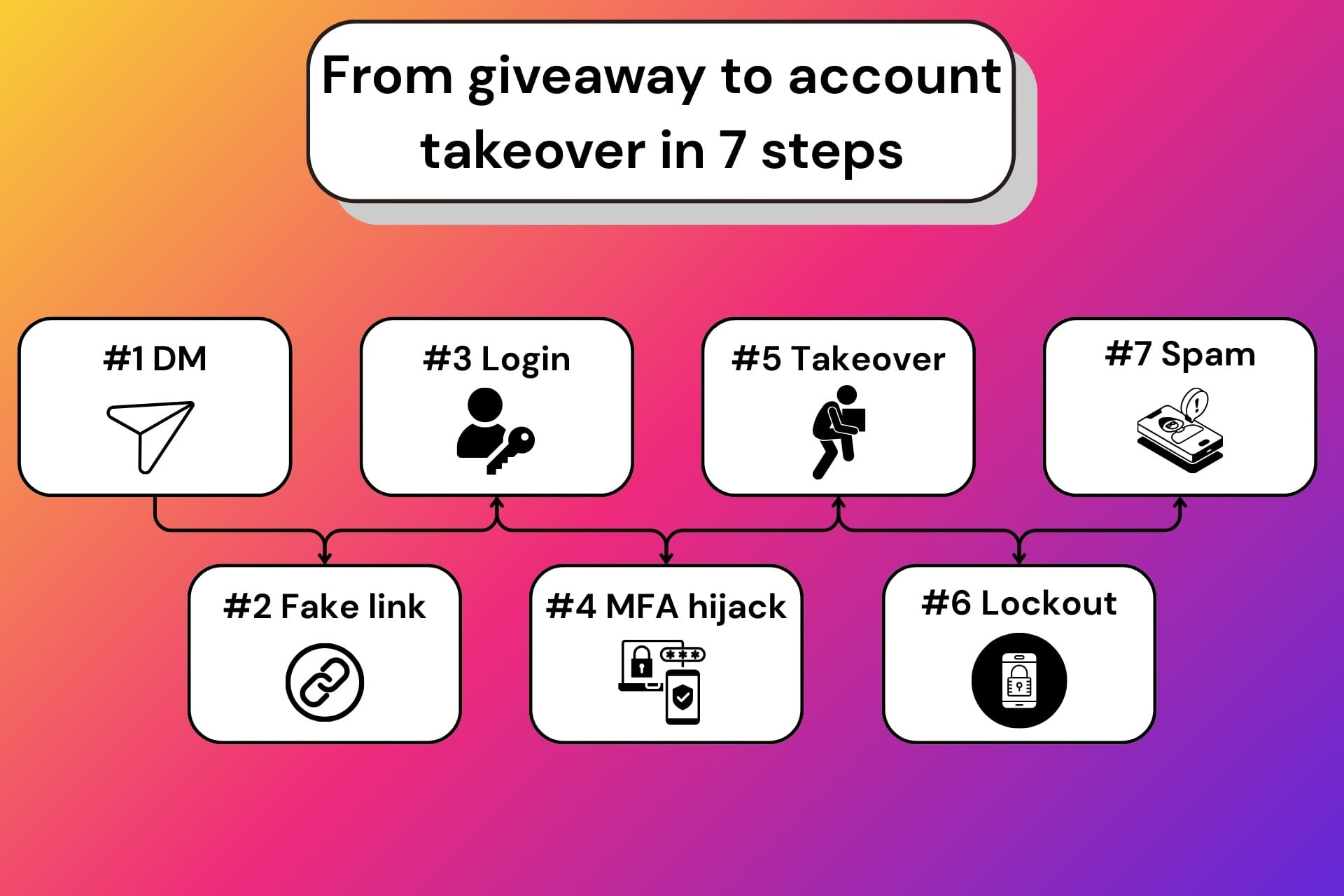
Here’s the typical funnel:
- Bait: Giveaway post, comment, reply or DM
- Pressure: “Winner must respond in 30 minutes” / “limited slots”
- Redirect: Link shortener, “form” or “claim page”
- Credential harvest: Fake Instagram login page
- MFA interception: Page asks for a code or attacker prompts it immediately
- Takeover: Attacker logs in, changes your email and password, disables your MFA, locks you out
- Abuse: Scams sent from your account, ad fraud, impersonation, extortion, resale
This is why fake login pages are so dangerous. Giveaways are wrongfully deemed as mere scams when, in fact, they’re social engineering wrappers for full account takeovers.
How do I know if a giveaway is legit?
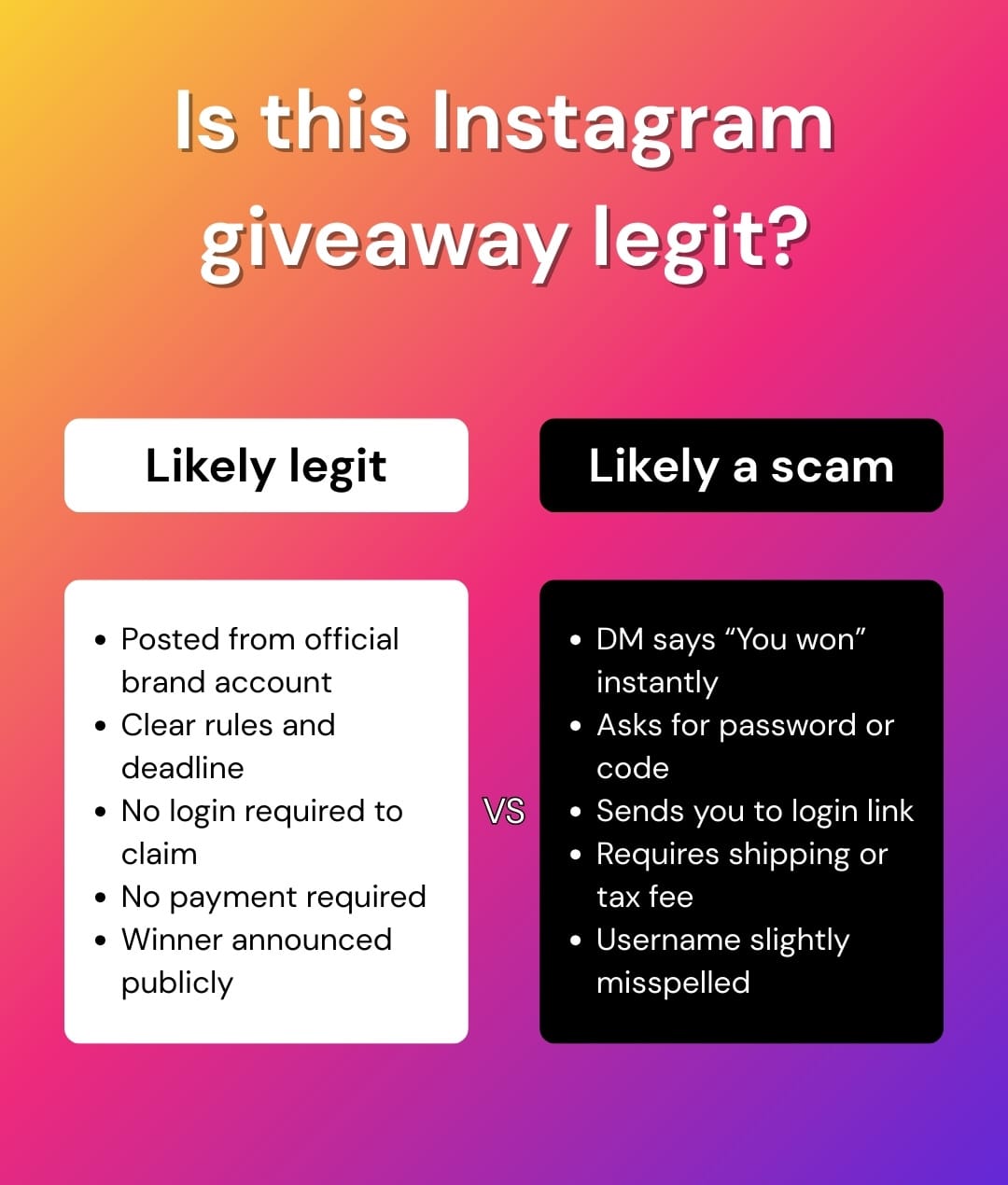
A legit giveaway can still be annoying, as many of the requirements could err on the side of spammy. However, a scam giveaway tends to be pushy and sloppy. Watch out for:
- You must click a link to “confirm” your Instagram account
- They ask for your login details or an authentication code (real brands don’t need this)
- Payment required for “shipping,” “tax,” or “processing” to receive a prize
- Handle doesn’t match the brand, with extra underscores, misspellings or random numbers
- Account is new or has odd engagement patterns, such as lots of comments or few real interactions
- Urgency and threats – “respond now or lose your prize”
- Link shorteners or domains that aren’t clearly Instagram/Meta/brand-owned
- Weird “winner selection” mechanics (DM-only, secretive rules, no public terms)
How to check if a message is from a scammer?
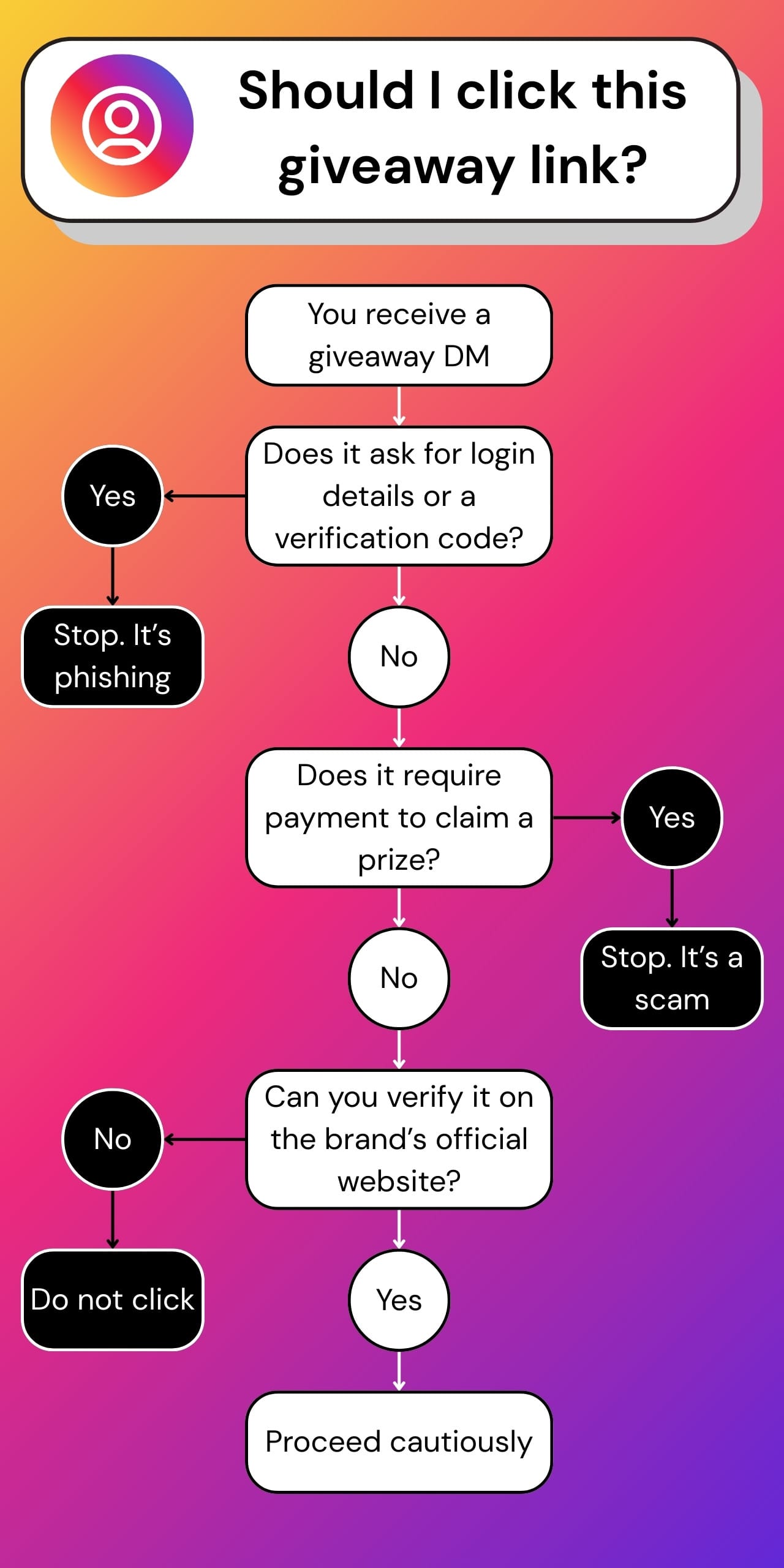
One of the cleanest anti-phishing habits is to never trust the message channel and always verify inside the app. Meta has explicitly pointed users to the “Emails from Instagram” area as a place to see genuine Instagram communications in-app.
Here are some more verification steps to keep you safe from scammers:
- Search the brand manually instead of relying on DM links. Open the official website and navigate to their Instagram page
- Check the account carefully: elements like the account’s handle, post history or comment quality could be dead giveaways that something’s off
- Don’t trust the verification badge; although it was introduced as a means for businesses to display their authenticity, attackers now exploit it to mask their malicious intentions
- Avoid logging in from links. If you need to log in to your account, open your Instagram app and do so there
- If a “giveaway win” message requires you to confirm your identity, pause and contact the brand manually via an official contact method (website, email, phone number), not a reply to the DM
- Use Bitdefender Scamio to verify suspicious giveaway links or DMs before clicking. Scamio is a free AI-powered scam detection assistant that analyzes links, messages, QR codes and screenshots in real time to flag phishing and fraud attempts you might otherwise miss
- Protect your Instagram and other social accounts with Bitdefender Security for Content Creators. This comprehensive security suite offers continuous account monitoring, advanced anti-phishing protection, real-time alerts for unauthorized activity and dedicated support for Instagram creators to prevent account takeovers and quickly recover if compromised
What happens if you accidentally click on a phishing link?
If you accidentally interact with a suspicious giveaway link (especially if you entered information such as your credentials or authentication code), treat it like a live security incident:
- Change your password for Instagram and anywhere else you reused it
- Change your email password (email takeover is how attackers hijack your recovery path)
- Enable stronger authentication (app-based MFA, consider passkeys if available)
- Check login activity/sessions and sign out of unrecognized devices
- Warn friends if your account messaged them or posted scam content
- Report the account/post in Instagram and consider reporting the fraud to the FTC
Conclusion
It’s a good idea to make it a habit to always treat giveaways with suspicion. Assuming that every “you won” message is a phishing attempt until proven otherwise won’t give you that brand new iPhone or surprise trip to a tropical island, but it will keep your accounts and money safe. Fake giveaways are popular because they scale cheaply, and because the “prize” storyline is an easy way to get you onto a fake login page.
To keep it short, you should never pay to get a prize, avoid logging in through links you receive via DM and always verify inside the Instagram app instead of inside your DMs.
Frequently asked questions (FAQ)
How do I know if a giveaway is legit?
A legit giveaway will come from verified or clearly established brand accounts, include clear rules and deadlines and won’t ask for your password, authentication code or payments to claim a prize.
How do you know if it’s a scammer on Instagram?
Common red flags include:
- Slightly misspelled usernames or extra symbols
- Urgent DMs saying you “won” something
- Requests for login details or authentication codes
- Links to unfamiliar websites
- Demands for shipping or processing fees
Real brands don’t need your password or fees to give you a prize.
Are Instagram giveaways legal?
Yes, legitimate giveaways are legal in many countries, but they must follow advertising and consumer protection laws. The problem isn’t with giveaways themselves, it’s scammers impersonating brands to steal credentials, personal data or money.
tags
Author

Vlad's love for technology and writing created rich soil for his interest in cybersecurity to sprout into a full-on passion. Before becoming a Security Analyst, he covered tech and security topics.
View all postsYou might also like
Bookmarks
