Instagram Drops Encrypted DMs — What This Means for You

May 11, 2026

Instagram parent company Meta has quietly abandoned encrypted direct messages on the popular social media platform, marking a reversal in the company’s push toward privacy-centric messaging.
As of May 8, Instagram users can no longer send end-to-end encrypted DMs, according to updated support documentation. The decision comes less than a year after Meta disclosed plans to use conversations with its AI assistant to personalize ads and content recommendations across Facebook and Instagram.
Key takeaways
- Meta has officially ended end-to-end encrypted (E2EE) direct messages on Instagram.
- Meta can now access and process private Instagram chats for moderation and other internal purposes.
- The move reverses years of Meta messaging around ‘privacy-focused’ communication.
- Meta previously announced plans to use conversations with its AI chatbot to personalize ads and recommendations across Facebook and Instagram.
- The combined changes could significantly expand the amount of user data available for profiling and advertising.
A sharp reversal on encryption
Meta spent years publicly advocating for stronger encryption across its platforms.
CEO Mark Zuckerberg earlier described private, encrypted messaging as the future of social networking. Instagram’s optional E2EE chats were gradually introduced starting in 2023 as part of that broader strategy.
Now, that feature is gone.
According to Meta, “very few people” used encrypted Instagram chats, and the company is encouraging users who want secure messaging to switch to WhatsApp instead.
Instagram’s help documentation says encrypted conversations and associated media may need to be downloaded before access disappears.
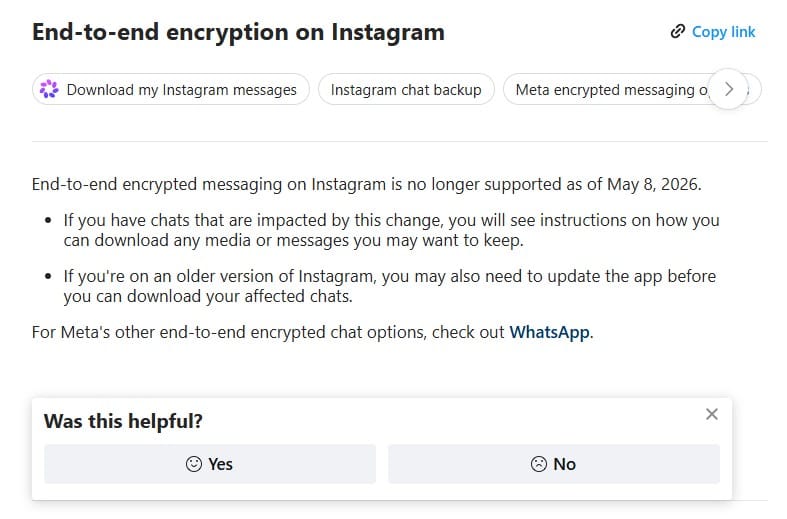
An Instagram support document informs users that messaging on the social platform is no longer end-to-end encrypted
Without E2EE, messages are no longer protected from attackers taking over a person's account or from Meta itself accessing their contents.
Meta’s AI ad personalization push
In late 2025, Meta announced it would begin using interactions with Meta AI to personalize ads and content recommendations.
The policy applies to conversations with Meta AI across services like Facebook, Instagram, Messenger, and some Meta-integrated apps.
According to Meta, the system can use AI chat interactions to influence:
- Ads shown across Meta platforms
- Recommended posts and reels
- Personalized content experiences
Meta says it excludes certain sensitive categories from ad targeting, including religion, health, race, politics, and sexual orientation.
However, modern AI systems can infer highly sensitive traits indirectly from broader behavioral data. That means even seemingly harmless conversations, interests, or interaction patterns could contribute to detailed profiling over time.
Why Meta may be stepping back from encryption
The change may, in part, be tied to safety and moderation challenges. Encrypted systems make it much harder for platforms to detect scams, abusive material, harassment, or other policy violations because message content cannot be read server-side.
The company has also faced regulatory pressure around child safety and content moderation.
Privacy at stake?
The combination of weaker privacy and AI-driven personalization, some may argue, could reflect an industry trend. Social platforms increasingly rely on AI systems trained on massive volumes of user interaction data to improve engagement and performance.
For users, the practical impact is that conversations, behavioral patterns, and interactions may become more valuable inputs into recommendation and monetization systems.
Removing E2EE increases the potential exposure surface for sensitive communications in the context of AI training (profiling), account compromise, or a data breach.
What Instagram users should do now
If you’re concerned about privacy, reconsider what information you share through Instagram DMs. Here are some practical steps:
- Avoid sharing sensitive personal or financial information over Instagram
- For super private conversations, lean toward apps with default end-to-end encryption
- Review Meta privacy and ad preference settings regularly
- Download old encrypted chat archives if needed
- Be cautious about what you share with AI chatbots and assistants
As a rule of thumb, keep in mind that your social media interactions may (and often do) contribute to personalization models.
You may also like to read:
Fake WhatsApp Clone Used in Spyware Campaign, Meta Warns
Social Media Scams Cost Americans $2.1 Billion in 2025, FTC Warns
The Online Safety Act Is Changing the Internet for Kids — But Families Say It’s Still Not Enough
tags
Author

Filip has 17 years of experience in technology journalism. In recent years, he has focused on cybersecurity in his role as a Security Analyst at Bitdefender.
View all postsYou might also like
Bookmarks
