Black Friday Scam Report: Familiar Brands, Fake Deals and the Early Global Shopping Rush

November 19, 2026
The traditional Black Friday may fall on November 27 this year—the day after Thanksgiving in the US—but the global shopping calendar no longer follows a single day.
In Romania, the waves of Black Friday and pre-Black Friday offers began in late October. Elsewhere, retailers are already running early-access events, sales weeks and “Black November” promotions. That gives scammers a much wider window to send fake deals, impersonate trusted brands, and hide fraudulent offers among legitimate marketing.
This report draws on Black Friday-themed scam activity observed by Bitdefender Labs between October 30 and November 10, 2026. It’s an early snapshot of a shopping season that’s already well underway in many markets and will continue to evolve in the weeks ahead.
Key takeaways
- Half of Black Friday-themed email campaigns observed by Bitdefender Antispam Lab were marked as scams, showing how quickly seasonal shopping promotions can be repurposed into phishing, fake rewards and fraudulent offers.
- Long before the official shopping day, Black Friday scams are active across email, SMS, social-media ads and suspicious storefronts.
- The United States accounted for 46% of Black Friday-themed scam emails observed by Bitdefender Antispam Lab, followed by Germany at 14%, Japan at 9%, Ireland at 9% and Romania at 6%.
- Luxury products, electronics, gift cards, giveaways, vouchers and “exclusive” early deals are among the most common email lures.
- APAC is the primary target of global Black Friday luxury-goods scam email campaigns.
- Social-media ads are being used to imitate brands and direct consumers to fake shops, misleading deal guides or unrelated affiliate pages.
Email scams: Black Friday inboxes fill up early
Half of the Black Friday-themed spam emails Bitdefender Antispam Lab observed from October 30 to November 10, 2026, were marked as scams. This pattern mirrors our 2025 findings and shows how quickly legitimate marketing can be copied and turned into fraudulent offers, brand impersonation, and misleading reward notifications.
Bitdefender Labs researcher Viorel Zavoiu and Alecsandru Daj identified multiple Black Friday-themed email scam campaigns that used well-known brands and seasonal promotions to lure recipients to fraudulent platforms.
According to aggregated and anonymized Bitdefender Labs telemetry, the top destinations for this year’s Black Friday-themed scam emails sent between October 30 and November 10 were:
- United States: 46%
- Germany: 14%
- Japan: 9%
- Ireland: 9%
- Romania: 6%
- Czech Republic: 3%
- UK: 2%
- France: 2%
Italy, Australia, the Netherlands, Hungary, Canada, South Africa, Austria, Poland, Slovakia, Finland and Switzerland each accounted for 1% or less of the observed Black Friday-themed scam emails observed between October 30 and November 10 2026.
Black Friday is now a global shopping event, but its timing isn’t the same everywhere. While the traditional date falls after US Thanksgiving, retailers in many countries launch Black Friday sales weeks earlier, extend them across several days or blend them into “Black November” promotions. The absence of Black Friday-themed scams in a particular country during this early observation window should not be read as evidence that consumers there will not be targeted. Scam activity can emerge later in the season, shift between channels or use locally relevant brands and shopping themes.
Although the themes vary, all flagged Black Friday-themed email scams promise either a high-value product or a reward available for a limited time.
Some of the top observed 2026 Black Friday email lures include:
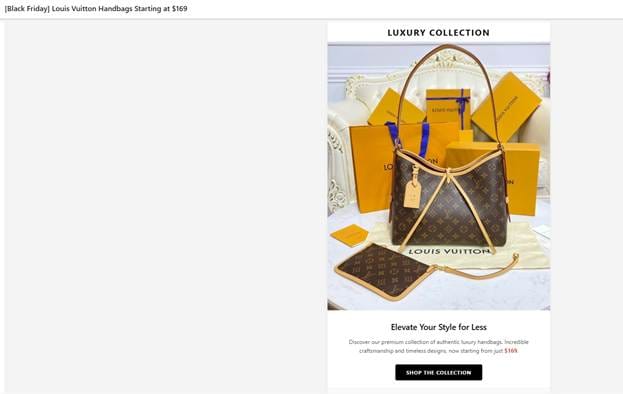
- Luxury handbag sale offers
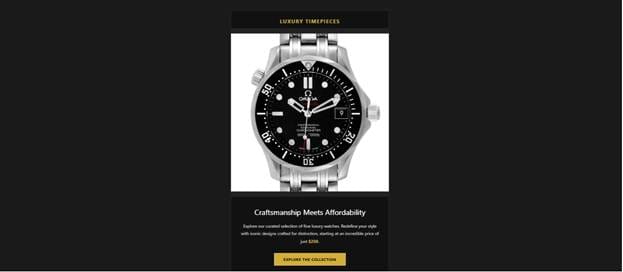
- Luxury watch and timepiece promotions
- Samsung TV and electronics deals
- Early Black Friday retail-deal emails
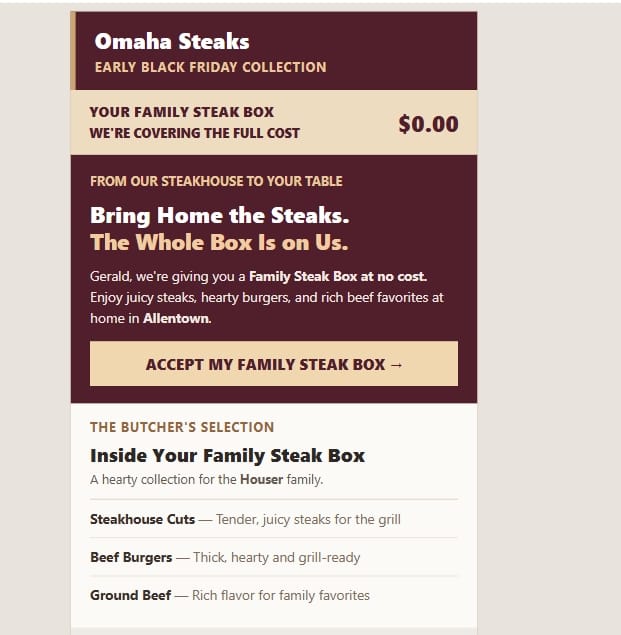
- Omaha Steaks “free steak kit” or meat-box offers
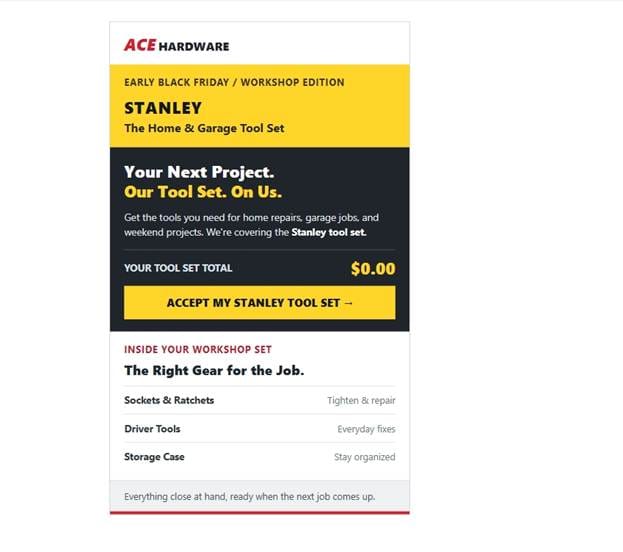
- Ace Hardware rewards
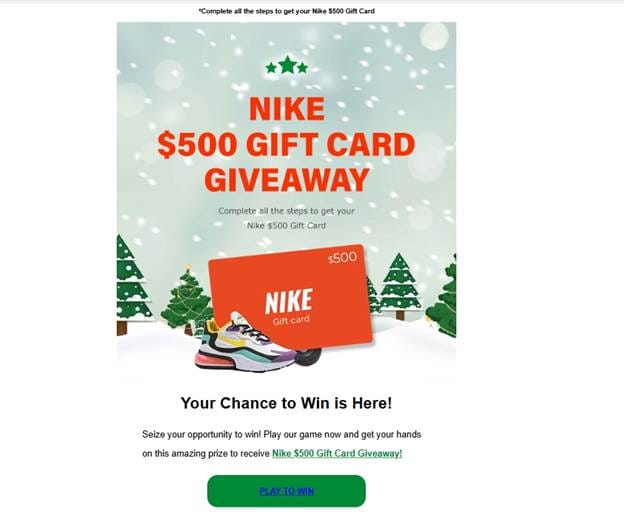
- Nike gift-card and giveaway messages
We also saw examples styled as Adidas promotions, Sam’s Club rewards, Louis Vuitton offers, Makita advent-calendar deals and insurance-related promotions.
None of the brands named in these examples are associated with these scam messages. The brand names, logos and visual identity were used without authorization to make the emails appear familiar and trustworthy.
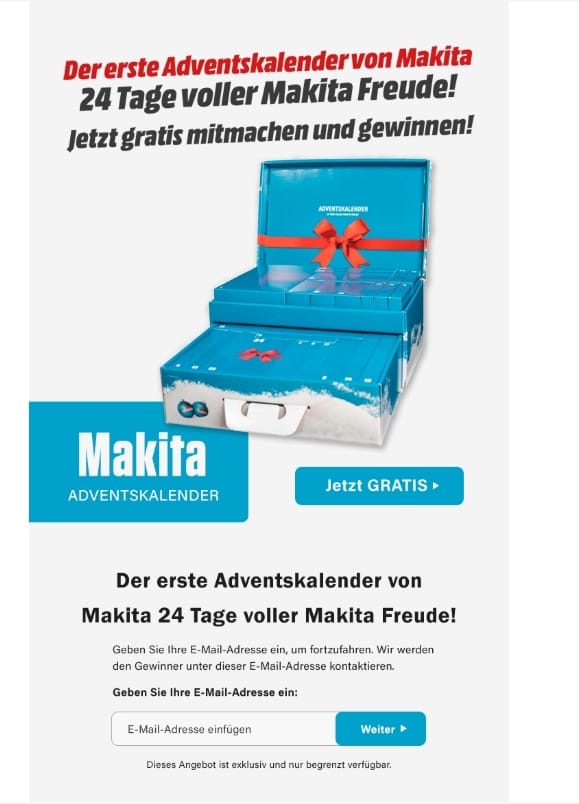

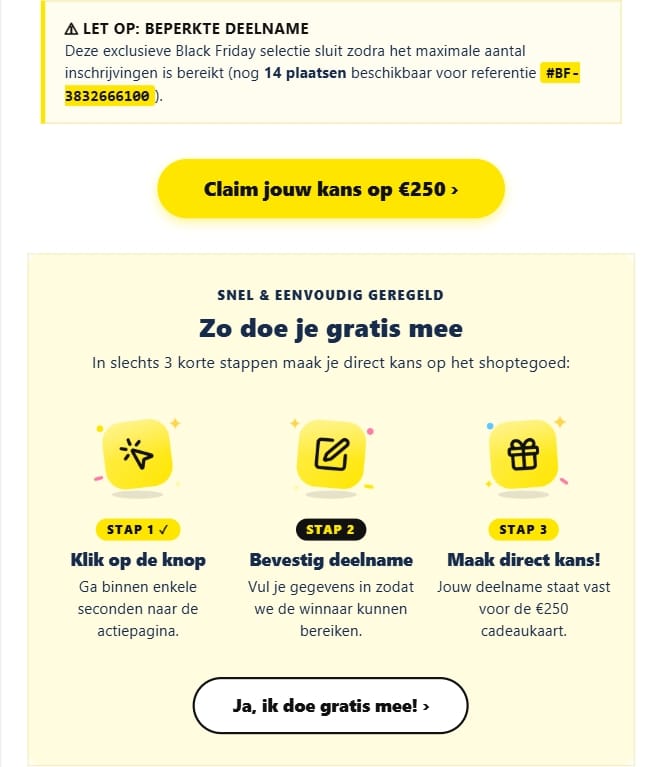
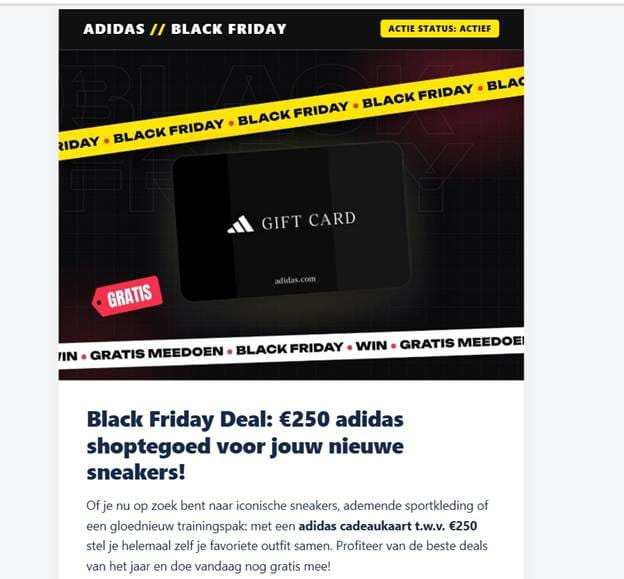
Luxury goods discount shopping remains a reliable lure
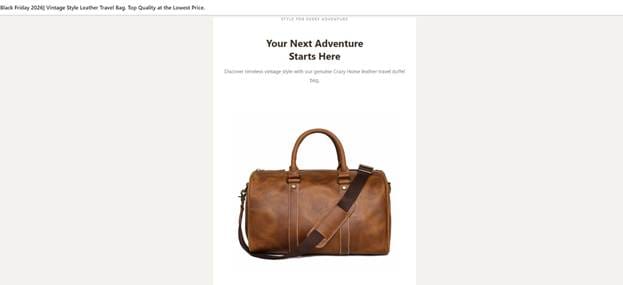
Luxury handbag and timepiece shopping scams are circulating globally, offering premium products at prices designed to feel exclusive, temporary and too good to miss. APAC is the primary target of the observed global luxury-goods scam email campaigns, with activity also reaching markets in Europe and North America.
These messages often imitate the tone of luxury retailers, using words such as “curated,” “exclusive,” “craftsmanship” or “limited collection.” A polished image of a watch or handbag does not prove that the offer is real.
‘Black Friday $5,000! Secret Link Access’ emails target US recipients
Another US-focused scam campaign used subject lines such as “Black Friday $5,000! Secret Link Access” to promise a supposedly exclusive cash reward. The message claimed that recipients had been randomly selected for a $5,000 Kanye West promotion, urging them to register, enter a “secret” promo code and claim the money through a purported rewards platform.
The landing page instructed users to create an account with their email address and password, then suggested they could play, grow their earnings or withdraw the reward. This combines several familiar tactics that include impersonating a celebrity, large cash promises and exclusivity.
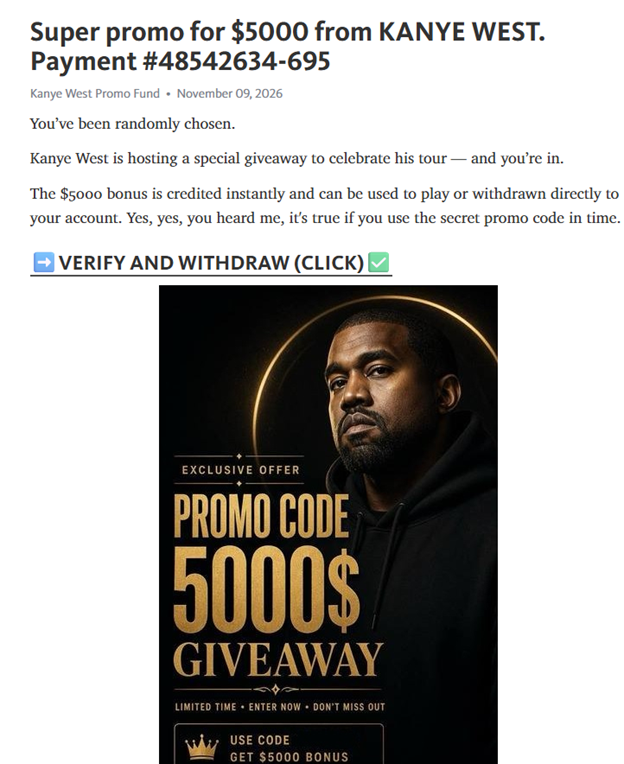
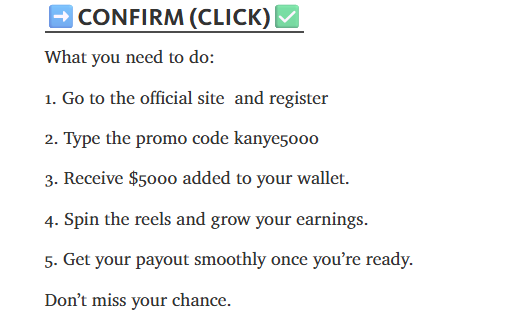
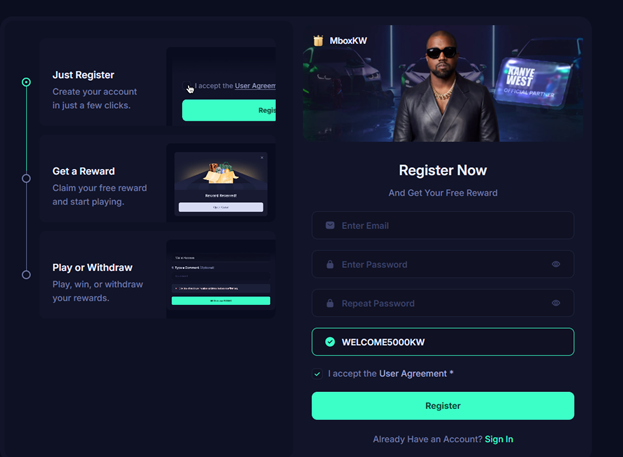
Kanye West is not associated with the messages, promotion or website. Consumers should never reuse an existing password when registering through a link received in an unsolicited email, and should treat celebrity-backed cash giveaways with particular caution.
Electronics offers and retail-style emails
Samsung-themed messages offered implausibly cheap smart TVs and electronics under Black Friday or “Black Month” branding. Some messages also referenced major retailers to add another layer of legitimacy.
Other campaigns imitated routine retail newsletters: curated shopping lists, early access, vouchers and seasonal savings. That’s exactly what makes them difficult to identify at a glance.

Giveaways, free products and gift cards
Bitdefender Labs also identified emails using “free” merchandise, reward balances, gift cards and giveaway entries as the hook. Examples included an Omaha Steaks-style free meat-box offer, Ace Hardware-style rewards and Nike gift-card giveaway messages.
A free product or reward is often only the first step. The next page may ask for a delivery fee, payment-card details, an account password or other personal information.
SMS scams: luxury fragrances, fake account credit and prize messages
Text messages are particularly effective during shopping season. A shopper may see a “limited stock” notification on their phone while commuting, at work or scrolling through legitimate offers.
In Romania, Bitdefender flagged an SMS scam campaign claiming to sell “authentic” Dior, YSL and Armani perfumes at dramatically reduced Black Friday prices, starting from 159 lei (approximately $33.39 USD at the time of writing)
“BLACK FRIDAY a inceput! Parfumuri originale Dior, YSL, Armani si alte branduri de la 159 lei si multe alte promotii. Stoc limitat: [redacted link]”
Translation:
“BLACK FRIDAY has begun! Original perfumes from Dior, YSL, Armani, and other brands starting at 159 lei and many other promotions. Limited stock: [redacted link]"
The message uses the promise of authentic luxury products, an unusually low price and limited-stock pressure to push people into acting quickly. These brands are generally sold through authorized retailers, which makes such an offer particularly implausible. Dior, YSL and Armani are not associated with this message or the linked website.
In South Africa, another SMS impersonated Mr Price Money, the financial-services arm of the Mr Price retail group, and combined Black Friday shopping language with a personalized prize and alleged account credit:
[NAME], get Black Friday deals on your Mr Price Money account & you can win up to R500000! You have R[AMOUNT] credit [redacted link] Stop2OptOut
Mr Price Money is not associated with this scam message.
Scam ads on social media: fake shops, impossible prices and misleading guides
Social-media ads have become an important delivery channel for Black Friday scams. A sponsored post can borrow the name of a trusted company, feature professional-looking images and lead users to a fake shop or misleading intermediary page.
One US campaign impersonated Starlink with a Black Friday ad for “St4rlnk Mini,” using a slight misspelling to evade basic brand checks:
🚨 BLACK FRIDAY JUST GOT MORE EXCITING! One compact device. More possibilities. Discover St4rlnk Mini and explore internet plans designed for different needs... Black Friday offers are here!
Starlink is not associated with this advertisement.
Another US ad impersonated Grunt Style, a veteran-founded apparel brand, offering apparel at extremely low prices across its entire offering.
“EARLY BLACK FRIDAY: Grunt Style – EVERY ITEM JUST $3! ...Grunt Style is the brand built by warriors, for warriors — proudly veteran-founded...”
The campaign used the brand’s connection to veterans and first responders to create familiarity and trust. Grunt Style is not associated with this advertisement or the fake shop behind it.
We also identified health supplement scam ads built around a fabricated historical medical narrative and a fictional doctor, closing with an early Black Friday sale:
“In 1925, 2 doctors in New York figured out why so many women get osteoarthritis right around their 50s... I’m Dr. Katherine Wells... It’s called UC-II... Balmve... early Black Friday sale. The same bundle is now $70.”
The ads present a product claim as a medical discovery story, then use a discount to pressure readers into buying. Readers should be cautious about health claims presented in social-media ads and consult a medical professional before buying supplements.
Fake branded storefronts promoted through paid ads
Social media is another major route for scam delivery during Black Friday. Fraudulent advertisements can imitate well-known brands, use polished product images and promise steep, limited-time discounts before directing shoppers to counterfeit storefronts.
We flagged multiple fake brand websites advertising “Black Friday up to 90% off” after users clicked paid ads that led to the fraudulent pages. The campaigns impersonated brands including Nike, Ugg, Ray-Ban and Michael Kors. In one case, a Nike-impersonating storefront was promoted through a paid TikTok ad, showing how paid advertising can be used to send shoppers directly to a fake store.
Nike, Ugg, Ray-Ban and Michael Kors are not associated with these advertisements or websites.
Remember: a paid ad is not a guarantee that a seller is legitimate. Always check the web address carefully and go directly to the retailer’s official app or website before entering payment details.
Carrier and retail “deal guides”
In the US, we also observed campaigns using T-Mobile, Spectrum, Metro and AT&T branding to promote Black Friday phone-upgrade “deal guides.” These ads can redirect users to unrelated affiliate, lead-generation or search-arbitrage pages rather than the official carrier.
Walmart-branded Black Friday ads followed a similar pattern, using the retailer’s name to attract clicks before sending users to unrelated pages. Walmart, T-Mobile, Spectrum, Metro and AT&T are not associated with these ad scam campaigns.
Not every risky campaign is a confirmed scam
Alongside confirmed malicious activity, Bitdefender Labs also observed aggressive marketing campaigns that can confuse shoppers, even where they have not been confirmed as fraudulent.
For example, in Romania, some online storefronts used Black Friday messaging across thousands of ads. In the US, ads used Walmart, T-Mobile, Spectrum and AT&T branding to push shoppers to unrelated affiliate or lead-generation pages. These campaigns can still confuse shoppers, particularly when they use a familiar brand to draw people away from its official website.
What you need to remember is: if an ad does not lead directly to the retailer it claims to represent, don’t continue through the funnel.
Delivery scams: an adjacent risk
This report focuses on Black Friday-themed campaigns that explicitly use shopping deals, rewards, giveaways and promotional offers as their lure. It does not include delivery-themed scams, even though they often go hand in hand with online shopping and tend to become more relevant as orders begin to arrive.
During the Black Friday pre-ramp period, Bitdefender observed spikes in delivery-themed scam and phishing activity, particularly on October 31 and November 3. FedEx was the most frequently impersonated delivery or logistics brand by volume. Amazon activity was nearly as large, although many of those messages used delivery-notification or shipping-status lures rather than classic courier-only scams. EVRI, DHL and DPD were also clearly present. FedEx, Amazon, EVRI, DHL and DPD are not associated with these scam campaigns.
The pattern is worth keeping in mind: a fake deal can steal payment details before a purchase, while a fake delivery notification can arrive afterwards, claiming there is a missed parcel, customs fee or address issue to resolve.
How to shop more safely this Black Friday
Do not let a sense of urgency make the decision for you. Before you buy:
- Open the retailer’s official app or type its address into your browser yourself instead of following an email, text or ad link
- Treat dramatic discounts on luxury goods, electronics and gift cards with extra caution
- Be skeptical of unexpected prize notifications, reward balances and free-product offers
- Check the website address for misspellings, unusual endings or extra words added to a brand name
- Never enter payment details on a page you reached through an unsolicited message without verifying the seller first
- Keep security protection enabled across your devices to help block phishing pages, fraudulent shops and malicious links
This Black Friday, give yourself something more useful than another discount: a little more confidence while shopping online.
Use Scamio when a message, offer or seller does not feel right. Check suspicious URLs with Link Checker before opening them. And with the newly launched Bitdefender Web Sage, you have an extra layer of guidance while browsing, helping you spot risky websites, scams, phishing attempts and fake stores before they can turn into a costly mistake.
Free versions of Bitdefender Scamio, Link Checker and Web Sage are available on our website. Paid features may require a subscription.
For broader protection, choose a comprehensive Bitdefender security solution with scam and malware protection across your devices. Whether you’re shopping from your laptop, phone, or tablet, it can help protect your accounts, personal information, and payment details wherever Black Friday browsing takes you.
Disclaimer
This report is published for informational and educational purposes only. The findings presented are based on research conducted by Bitdefender Labs using publicly available information and aggregated, anonymized threat intelligence. Bitdefender is a provider of security products, some of which are mentioned in this report, and proprietary. The mention of specific domains, entities, brands, or trademarks does not imply any endorsement, affiliation, or official relationship. All trademarks referenced herein are the property of their respective owners and are used only to identify the brands impersonated by third parties. Bitdefender makes no representations or warranties regarding the accuracy or completeness of third-party information. Readers are encouraged to verify any information independently before taking action.
tags
Author

Alina is a history buff passionate about cybersecurity and anything sci-fi, advocating Bitdefender technologies and solutions. She spends most of her time between her two feline friends and traveling.
View all postsYou might also like
Bookmarks
