Bank refused to refund for a scam? How to complain and escalate

August 25, 2026
If your bank refuses a scam refund, it doesn’t necessarily mean the process is over. A solid complaint should show what happened, why the bank may be wrong, and the remedy you want. The next steps then depend on where you live and how you paid.
Key takeaways
- A rejected scam claim can often be challenged through the bank’s formal complaints process and, where available, an independent ombudsman or regulator
- Whether you authorized the payment yourself or a criminal initiated it can fundamentally change your refund rights
- Build your complaint around a clear timeline, transaction evidence, the bank’s stated reason for refusing reimbursement and the rules relevant to your case
- Act promptly, preserve your evidence and avoid anyone promising to recover your money for an upfront fee
Bank refused to refund you after a scam? Start with the reason
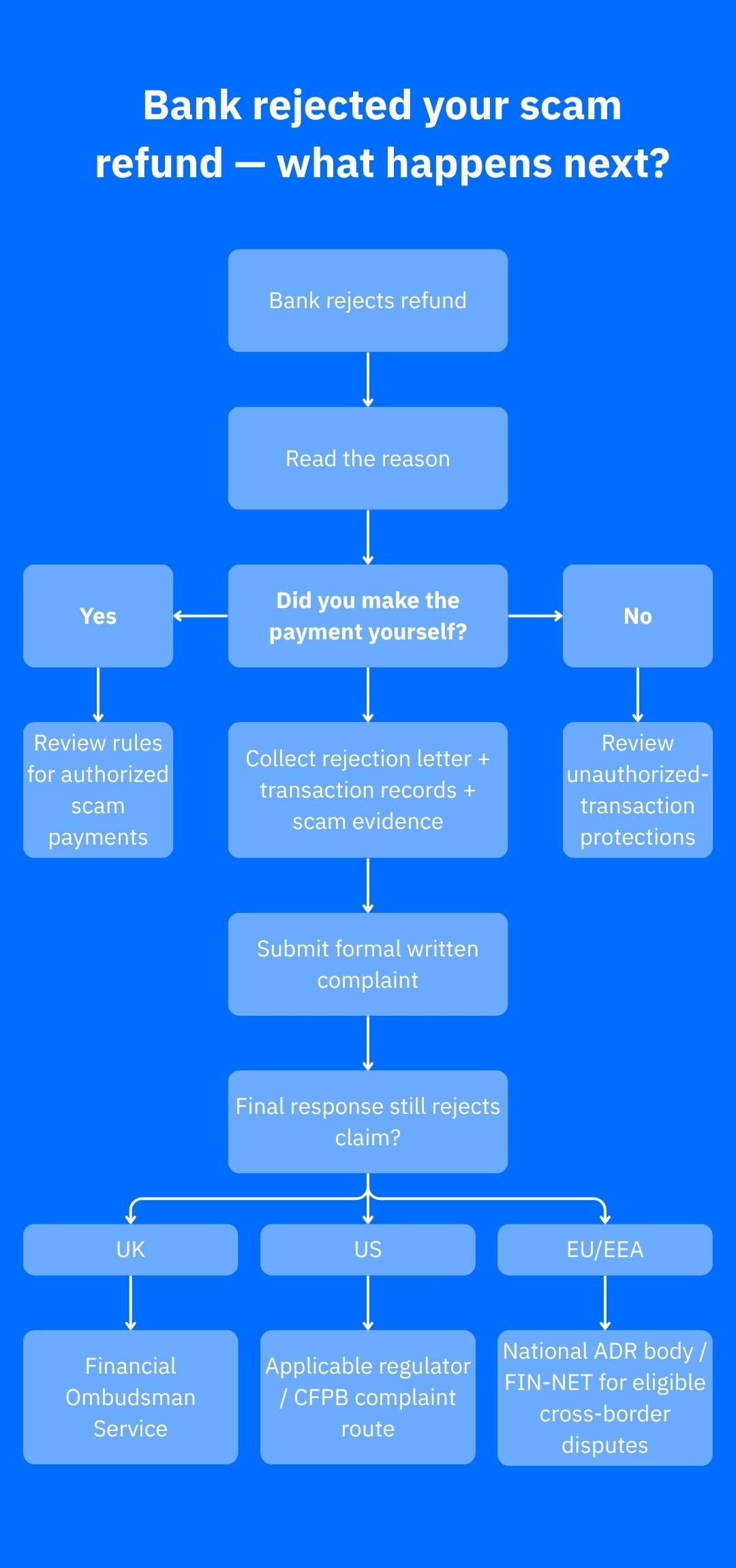
Don't treat a rejection letter as the final word. First, establish why the bank refused reimbursement. Common questions include whether you made the payment yourself, whether someone used stolen credentials, what warnings you received, and what the bank did after you reported the scam.
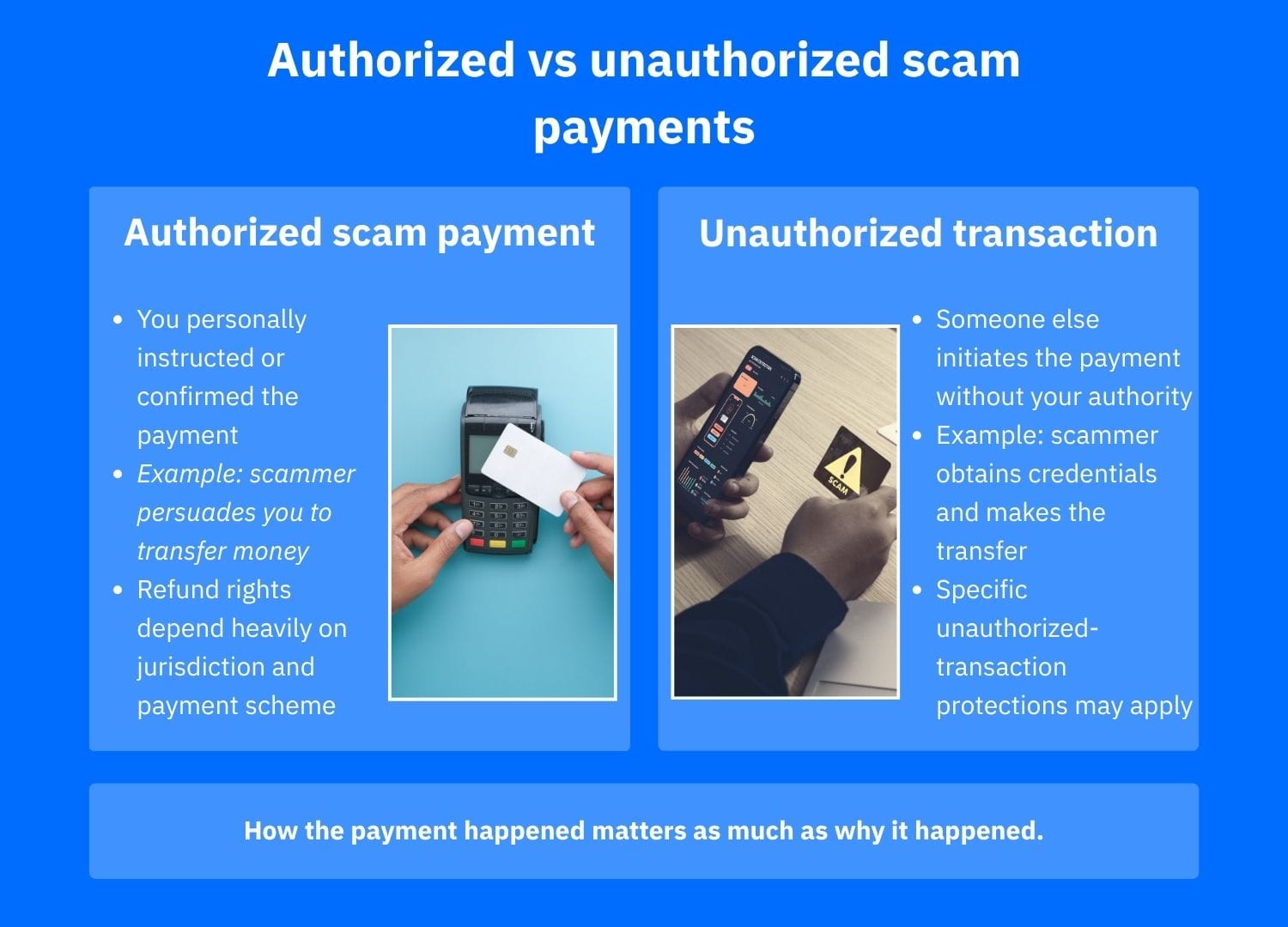
This distinction between authorized and unauthorized fraud is crucial. In the US, for example, the CFPB says an electronic transfer initiated by a fraudster using account information obtained through deception can qualify as an unauthorized electronic fund transfer, even if the victim was tricked into revealing their credentials.
Before appealing, collect the material in our scam evidence checklist, including messages, payment records, screenshots and correspondence with your bank.
How to write a bank scam complaint
Your complaint should make it easy for someone who has never seen the case to reconstruct it. Avoid a long emotional narrative without dates or evidence. At the same time, don’t reduce the complaint to “I was scammed, refund me.”
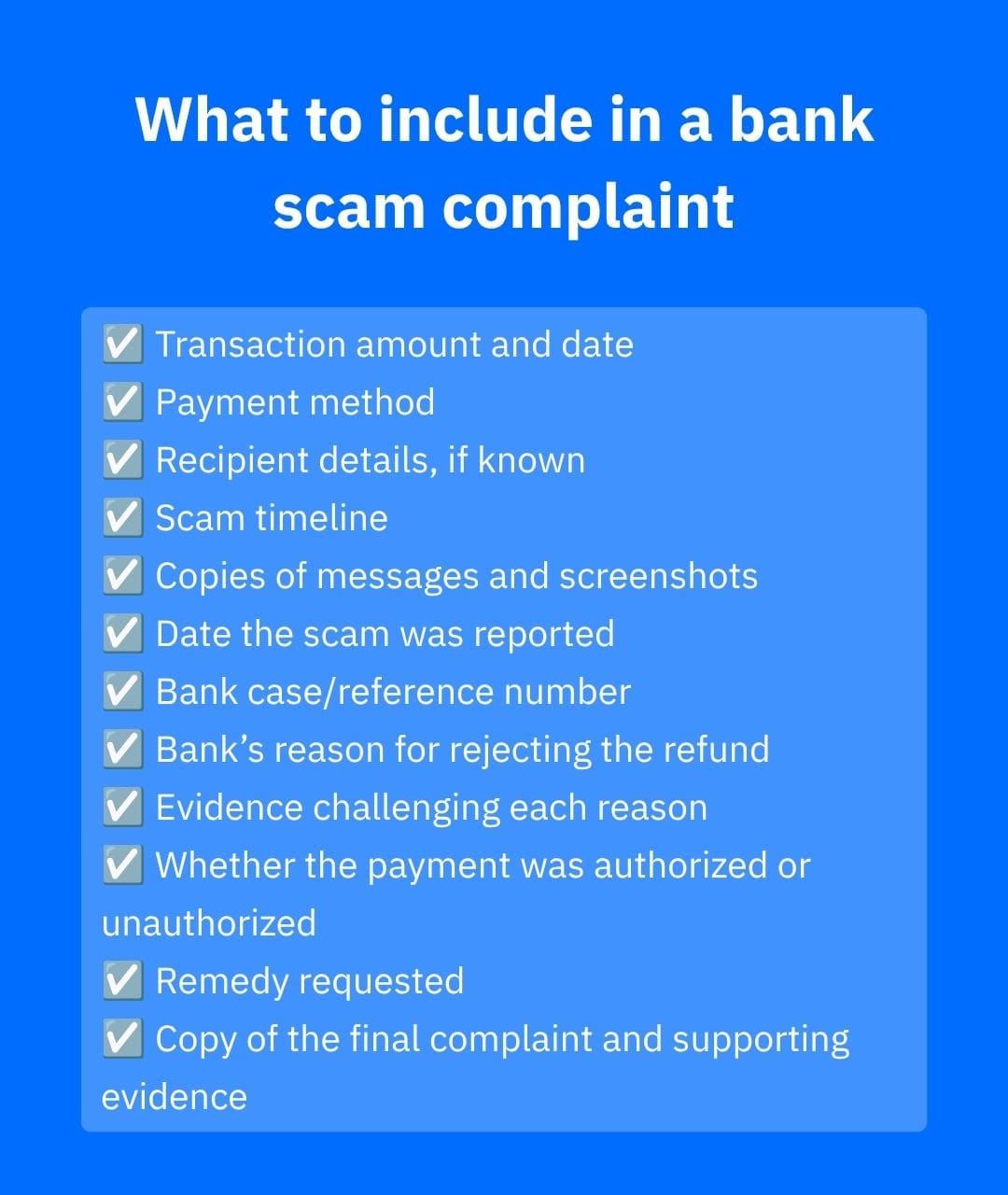
Include:
- The disputed transaction: amount, date, payment method and recipient where known
- A chronological account: how contact began, what the scammer claimed and what happened before and after payment
- Whether you authorized the transaction: distinguish between making a payment yourself and a criminal accessing your account and initiating it
- What you reported and when: include previous fraud reports, case numbers and conversations with the bank
- Why you dispute the rejection: quote or summarize each reason the bank gave and explain which evidence contradicts it
- What you want: normally reconsideration of the claim, reimbursement where applicable and a written explanation of the final decision
If the loss involved a transfer you initiated, our guide on what to do after you have sent money to a scammer by bank transfer covers the immediate recovery steps.
How to escalate a rejected bank scam claim
Refund rights are jurisdiction-specific, so the strongest escalation depends on the rules governing your account and payment.
UK
For qualifying UK APP scams, mandatory reimbursement rules have applied to many Faster Payments and CHAPS transfers since 7 October 2024. The current limit is £85,000, and qualifying claims generally must be reported within 13 months. Where the rules apply, a provider rejecting reimbursement generally must demonstrate that the consumer acted with gross negligence; special protections apply to vulnerable consumers.
Complain to the bank first. For fraud, scam and payment-services complaints, the Financial Ombudsman Service says firms generally have 15 business days to respond, with up to 35 business days where additional time is justified. If the final response is unsatisfactory, consumers normally have six months to refer the case to the Financial Ombudsman Service.
US
For an unauthorized electronic fund transfer, Regulation E provides specific error-resolution rights. A qualifying notice generally needs to reach the financial institution within 60 days of the statement first showing the error; institutions normally have 10 business days to investigate or may extend the investigation subject to provisional-credit requirements and other conditions.
If the bank denies the claim, Regulation E also requires a written explanation and allows the consumer to request documents relied on during the investigation. Unresolved complaints can be submitted through the Consumer Financial Protection Bureau complaint process, where companies generally respond within 15 days and may take up to 60 days for a final response.
EU and EEA
Under the current PSD2 framework, an unauthorized payment generally must be refunded immediately and no later than the end of the next business day after the provider becomes aware of it, unless the provider has reasonable grounds to suspect fraud by the payer and reports those grounds appropriately.
That rule should not be confused with a universal refund right for every payment a victim personally authorized after being deceived.
Consumers with unresolved cross-border financial-services disputes in the EEA can use FIN-NET to identify the relevant national out-of-court dispute-resolution body.
How Bitdefender can help reduce the risk of another scam
After a scam, criminals may try again, including through fake recovery offers. The FTC specifically warns that recovery scammers may promise refunds while demanding fees or financial information.
Before responding to an unexpected bank message, you can submit the text, email, screenshot, link or QR code to Bitdefender Scamio for a second opinion. If credentials were exposed, Bitdefender SecurePass can help replace reused passwords with separately managed credentials.
Bitdefender Digital Identity Protection monitors for exposed personal information and data breaches, while Bitdefender Ultimate Security combines device, scam, privacy and identity protections.
Conclusion
If your bank refused a scam refund, focus your appeal on evidence and the legal classification of the transaction rather than simply resubmitting the original claim. Preserve everything, challenge the rejection point by point and use the appropriate independent complaints route before any deadline expires.
Frequently asked questions (FAQs)
How can I recognize a bank scam?
Bank scams often create urgency around supposed fraud, account suspension or stolen money. A major warning sign is being told to transfer money to “protect” it, disclose a verification code, provide remote access or keep the conversation secret. Verify unexpected contact through the bank’s official app or a trusted number instead.
How do I check if a bank message is real or fake?
Do not verify a bank message using the link, phone number or instructions contained in that same message. Open your bank's official app, type its known website yourself or call the number printed on your card or statement. The FTC recommends this independent-contact approach because scammers can convincingly impersonate banks.
Can a scammer do anything with my bank details?
It depends on which details were exposed. An account number alone does not automatically give someone online-banking access, but financial information can support fraud, targeted phishing or identity theft. The risk becomes much greater if the scammer also has login credentials, card information, personal identifiers or verification codes. Contact your bank if you disclosed sensitive banking information.
Is a text message from my bank a scam?
It could be genuine or fraudulent, so the sender’s name alone is not enough to decide. Fake bank fraud alerts commonly tell recipients to reply, call a supplied number or click a link. Do not interact with the message; independently contact your bank through its official app, website or trusted customer-service number.
tags
Author

Vlad's love for technology and writing created rich soil for his interest in cybersecurity to sprout into a full-on passion. Before becoming a Security Analyst, he covered tech and security topics.
View all postsYou might also like
Bookmarks
