If we can’t tell what’s fake, nothing is real
June 18, 2026
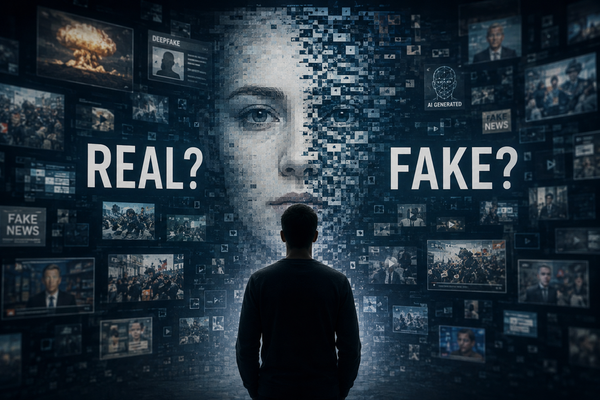
Deepfakes and misinformation have brought the Internet, one of humanity's greatest inventions, to a place that endangers the entire concept of shared information. It means the end of the Internet as we know it.
Or not.
The truth is that no one really knows.
The idea that we won’t be able to tell what's real and what's not on the Internet isn't new, but it's always been a prediction for some point in the future. That might no longer be the case, as much of the content generated today comes from AI agents or is created with the help of AI.
The advances made by this technology can’t be stopped, so the next logical step is to understand what’s happening, what we can actually do about it, and to map the possible futures.
Key takeaways
- Deepfakes don’t just make fake content easier to create. They also make real evidence easier to dismiss, giving liars a way to escape accountability.
- If people can no longer reliably tell what’s real online, they may shift from trust by default to suspicion by default. That might not kill the Internet, but it will weaken its role as a shared space for evidence.
- AI is both part of the problem and part of the solution. The same class of tools that can generate convincing fakes may also help detect manipulation, trace origins and build a new layer of verification.
There’s always more than one reason for everything
Such a complex problem won’t have a simple answer. In fact, not even a host of complex answers could be enough. And it’s possible that there is no answer, but you can rest assured that people have been wrestling with this problem since before there was even an Internet.
People who tell lies and people who try to share false information didn’t appear out of the woodwork with the Internet. They were always among us, and they’ve been a concern of thinkers and philosophers for millennia because they understood what happens when lies dominate.
One of those people was Hannah Arendt, a 20th-century philosopher well known for her work in political theory. While it might not sound like it has anything to do with deepfakes and misinformation, the base problem is the same.
Her original reasoning concerned totalitarian propaganda, factual truth and organized lying, but it turns out that the basic principles still apply.
This is what she wrote in The New Yorker magazine in 1967.
“Facts and opinions, though they must be kept apart, are not antagonistic to each other; they belong to the same realm. Facts inform opinions, and opinions, inspired by different interests and passions, can differ widely and still be legitimate as long as they respect factual truth. Freedom of opinion is a farce unless factual information is guaranteed and the facts themselves are not in dispute.”
If I hadn’t specified that she wrote this in 1967, it would be easy to apply to today’s world.
“And since factual truth, though it is so much less open to argument than philosophical truth, and so obviously within the grasp of everybody, seems often to suffer a similar fate when it is exposed in the marketplace—namely, to be countered not by lies and deliberate falsehoods but by opinion—it may be worthwhile to reopen the old and apparently obsolete question of truth versus opinion.”
Arendt was worried about the boundary between fact, fiction, opinion and fabricated reality, and this is the core of the deepfake and misinformation crisis we’re seeing today.
The liar’s dividend
Deepfakes, on every level, are lies, and lies are easier to define. They also help us understand where we are in relation to “the end of the Internet” as a space to share information and ideas. A couple of law professors, Bobby Chesney and Danielle Citron, formulated an interesting principle: the liar’s dividend.
“Liars aiming to dodge responsibility for their real words and actions will become more credible as the public becomes more educated about the threats posed by deep fakes.”
“Imagine a situation in which an accusation is supported by genuine video or audio evidence. As the public becomes more aware of the idea that video and audio can be convincingly faked, some will try to escape accountability for their actions by denouncing authentic video and audio as deep fakes. Put simply: a skeptical public will be primed to doubt the authenticity of real audio and video evidence. This skepticism can be invoked just as well against authentic as against adulterated content.”
The liar’s dividend is the moment when the existence of fake media begins to protect real liars. Once convincing fakes are possible, authentic evidence no longer speaks for itself. Every real recording must now survive a new layer of suspicion: not “what does this show?” but “is this even real?” That uncertainty is useful to anyone interested in escaping blame.
The liar’s dividend is an intermediate stage between “fake content exists” and “nothing can be trusted.”
The Error Management Theory
There’s a simple and efficient evolutionary theory that explains, among many other processes, how the more cautious ancestors were the ones to survive in the savanna; not necessarily the fittest, the strongest, the quickest, or the best adapted.
It all boils down to the two choices people make in any situation. When that situation is a life-or-death one, evolution favors the ones who favor the less costly decision.
The two choices are simple:
A type I error is a false positive: "I thought the wind was a predator."
A type II error is a false negative: "I thought the predator was the wind."
You hear something moving in the tall grass. If you think it’s the wind, but it’s actually a predator, you’re dead. If you first assume it’s a predator (even if it’s actually the wind), you have an extra chance to survive. Evolution takes over and favors what could be a false assumption because it has the lowest possible cost.
The same reasoning can be applied to deepfakes and misinformation in general. If we reach a point where we find that we can’t really determine what is real and what is not in the digital world, we might as well assume that everything is fake. This has the lowest possible cost, but it also makes the Internet meaningless.
Tying the knot
This is where the three ideas meet.
Arendt warned that public life depends on factual truth. The liar’s dividend shows how deepfakes weaken even authentic evidence. Error Management Theory explains why, when uncertainty becomes too costly, people may choose the safer mistake: distrust first, verify later or maybe never.
That doesn’t mean the Internet ends in the literal sense. It means the Internet risks losing its role as a shared space for evidence. Videos, images, audio, documents and screenshots won’t disappear but they may no longer be trusted by default.
For now, we still have one advantage. The very AI systems that generate convincing fakes can also help detect them, trace their origins, and identify manipulation patterns. We’re in a narrow window where artificial intelligence is both part of the problem and part of the solution.
There might not be an answer to these very complex issues. But if there is a way forward, it may depend on using the same class of technology that created the crisis to build a verification layer before doubt becomes the default language of the Internet.
tags
Author
Silviu is a seasoned writer who followed the technology world for almost two decades, covering topics ranging from software to hardware and everything in between.
View all postsYou might also like
Bookmarks
