‘I found your hacked account’: inside the Rambler.ru recovery scam

May 26, 2026
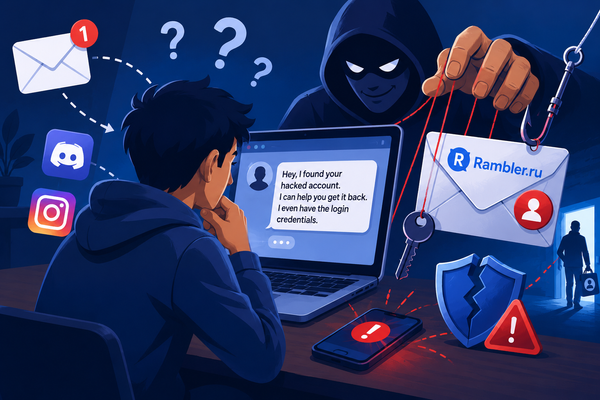
Your gaming account is suddenly hijacked. The emailer changes the email address to a Rambler.ru mailbox. Support requests go nowhere. A while later, perhaps weeks, a stranger appears on Discord or some other platform with an unexpected message:
“I found your account.”
“I can help you recover it.”
“I even have the login credentials.”
For many victims, the interaction seems out of place but not necessarily malicious. The stranger already knows details of the stolen account and sometimes even the right credentials. In rare cases, the victim temporarily regains access.
That apparent helpfulness is exactly what makes the scam effective.
A new pattern is emerging in which cybercriminals target victims twice: first by stealing the account, then by exploiting the victim’s desperation to recover it.
At first glance, this doesn’t look like a traditional phishing attempt. There are no fake login pages or obvious malware links. Instead, the scam relies on something more powerful: a partial truth.
Key takeaways
- Recovery scams increasingly target people whose accounts were already stolen.
- Attackers sometimes return partial access to build trust or extract payments.
- Rambler.ru email addresses frequently appear in gaming-account takeovers.
- A “helpful stranger” may actually be the original attacker.
- Even if victims regain access temporarily, attackers often retain hidden recovery control.
- Official platform support remains the safest recovery path.
Why these scams feel believable
Traditional phishing depends on deception alone. Recovery scams work differently because the attacker often has legitimate access to the stolen account.
A target who receives a random phishing email will likely be skeptical, but a victim who’s speaking to someone who already knows the stolen email address, linked game accounts, purchase history or recovery details might not be as suspicious.
In reality, the attacker is quite probably the same person who stole the account in the first place.
The pattern usually unfolds in stages. First, the account gets compromised through phishing, credential stuffing, malware or social engineering. The victim then asks publicly for help on Reddit, Discord, Steam communities or social media. Shortly afterward, someone reaches out privately claiming they located the account or know how to recover it.
That sequence matters because the attacker doesn’t need to convince the victim that the account was stolen. The victim already knows that part is true.
The role of Rambler email addresses
Many victims who report gaming account theft mention Rambler.ru email accounts associated with the compromise.
Rambler is a legitimate Russian email provider, but it often appears in account-takeover cases because attackers use disposable mailboxes to replace the victim’s original email address during the takeover. Once the attacker controls the linked mailbox, they control password resets, verification workflows and recovery requests.
For victims unfamiliar with the service, the Russian-language interface adds another layer of confusion.
Rambler.ru is only one of the many email services used in this type of scam. The attackers could use Mail.ru, Yandex.ru, and many others. They might not even necessarily be based in Russia.
Why would an attacker return a stolen account?
This is usually the part that victims struggle to understand. If the criminals already control the account, why would they help recover it?
The answer depends on what the attacker actually wants.
Sometimes the goal is straightforward extortion. The attacker offers to “return” the account in exchange for payment, often posing as a middleman or ethical hacker.
A likely scenario is that the victim pays, receives temporary access, and later loses the account again because the attacker quietly retained recovery control through linked emails, trusted devices, OAuth connections or active session tokens.
Other times, the account itself is no longer the primary target.
The attacker may instead want access to:
· the victim’s main email account
· additional gaming platforms
· saved payment methods
· cryptocurrency wallets
· identity documents used during recovery verification
The original compromise becomes bait for a second-stage attack.
Attackers know many victims reuse passwords across services. If the victim logs into the attacker-controlled mailbox, stores credentials in the browser or follows recovery instructions provided by the scammer, the compromise can expand far beyond the original gaming account.
There’s also another scenario: the attacker wants to clean the account’s history. If they can convince the user to log back in, depending on the service, it might clear fraud flags or weaken the anti-abuse systems that might be in place.
What users should do
Victims facing account takeovers should treat unsolicited recovery offers as hostile by default, even when the person seems to have legitimate information.
The safest approach is to use the official platform support exclusively while securing the identity ecosystem around the compromised account. That means changing passwords on primary email accounts, reviewing connected services, revoking suspicious sessions and enabling strong multi-factor authentication using authenticator apps or passkeys whenever possible.
It’s also best to avoid interacting with attacker-controlled mailboxes attached to the compromise. Even if the credentials appear legitimate, logging into those accounts can expose additional information or deepen the compromise.
Most importantly, victims should resist pressure to continue conversations privately on Telegram, Discord, or other platforms where moderation and oversight disappear.
Importantly, a security solution such as Bitdefender Ultimate Security will help users stay clear of phishing pages, credential-stealing malware, dangerous emails and all other sorts of threats that are always present in the online world, especially in gaming communities.
FAQ
Is Rambler.ru malicious?
Answer: No. Rambler is a legitimate Russian email provider, but attackers frequently abuse Rambler accounts during gaming-account takeovers and recovery scams. Other email services can be used in these types of scams.
Can attackers really return stolen accounts?
Answer: Sometimes temporarily. Many retain hidden recovery access and can reclaim the account later.
Why would scammers help recover an account?
Answer: Usually, they are not helping. The goal may be money, additional credentials, identity information or long-term access.
Should users log into attacker-controlled recovery emails?
Answer: No. Treat attacker-controlled mailboxes as compromised and avoid interacting with them.
What is a recovery scam?
Answer: A recovery scam targets people who have already lost accounts, money, or data, promising recovery assistance while seeking additional payments or credentials.
Why do scammers move conversations to Discord or Telegram?
Answer: Private platforms reduce oversight and make it easier to manipulate victims.
Can third parties legitimately recover hacked accounts?
Answer: In most cases, only the platform provider can safely restore ownership.
Why do victims fall for these scams?
Answer: Attackers exploit panic, frustration, and hope after an account takeover.
What should users do after an account takeover?
Answer: Secure the primary email account, change passwords, enable MFA, revoke suspicious sessions and contact official support only.
Do recovery scams only target gaming accounts?
Answer: No. They also target victims of crypto theft, social-media takeovers, email compromise and marketplace fraud.
tags
Author

Silviu is a seasoned writer who followed the technology world for almost two decades, covering topics ranging from software to hardware and everything in between.
View all postsYou might also like
Bookmarks
