FBI Impersonation Scams: How Criminals Trick Victims into Sending Money

April 14, 2026
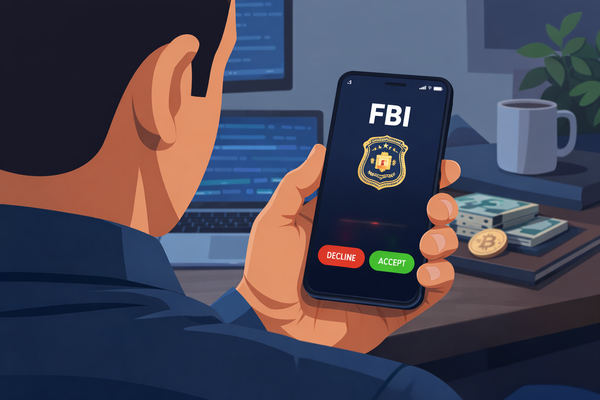
Scammers posing as FBI agents and government officials are targeting people with what seem like urgent calls, emails and messages designed to elicit fear and compel victims to make quick, poor decisions.
Victims are made to believe they are involved in criminal investigations or have financial problems, then get pressured into transferring money or sharing sensitive information.
Authorities have often warned that these scams are widespread and increasingly complex, with attackers using spoofed phone numbers, fake credentials, and detailed personal information to make them more credible.
Officials stress that no real law enforcement agency will ever ask for money or personal financial details over the phone or other channels.
Key Takeaways
- Scammers impersonate FBI agents or government officials to pressure victims into sending money
- They rely on fear, a sense of urgency, and secrecy to manipulate targets
- Law enforcement agencies never request money or sensitive information over the phone
- Requests involving wire transfers, gift cards, or cryptocurrency almost always signal a scam
- lways verify claims independently before taking action
What is an FBI impersonation scam
FBI impersonation scams are all about criminals who pose as federal agents, prosecutors or other government officials to trick potential victims into handing over money or sensitive information. These scams affect people across the United States and often originate from organized criminal groups operating internationally.
Fraudsters commonly reach out by phone, email or text, claiming that the call recipient is involved in a criminal investigation or at risk of falling victim to fraud. The message often differs, but the message remains the same: create a sense of urgency, gain trust and give a reason why a money transfer is needed before the victim has time to think.
How these scams work
These scams usually follow the same pattern: The attacker starts the conversation using spoofed phone numbers or fake credentials that make the entire discussion look legitimate. The conversation quickly shifts to a controlled environment where the victim feels pressured and isolated.
Scammers will insist on speaking only with the target and discourage them from contacting anyone else, including family members, companies or authorities. At the same time, they maintain an aggressive or urgent tone, pushing the victim toward compliance.
Once they establish control, the financial request quickly follows. Victims receive instructions to move money using methods that are difficult to trace or reverse, such as wire transfers, prepaid cards, mailed cash or cryptocurrency transactions.
Why scammers use fear and feigned authority
This type of fraud works because it exploits instinctive reactions. When people believe they are dealing with law enforcement, they tend to comply quickly and avoid questioning instructions.
Federal officials describe the tactic clearly:
“These fraudsters are capitalizing on fear and intimidation because nobody wants to be the victim of a crime or the subject of a law enforcement investigation,” said FBI Atlanta Acting Special Agent in Charge Peter Ellis in one of the multiple FBI warnings on the subject.
By combining authority with urgency, scammers create a psychological trap. Victims ignore verification and give in to the scammers’ demands to avoid trouble.
Common scenarios used by fraudsters
Although the details vary, these scams rely on a small set of recurring narratives. A caller may claim your identity was used in a serious crime, such as money laundering, and request verification of personal details. In other cases, they might say you missed jury duty or a court appearance and now face arrest unless you pay a fine.
Some victims are warned that their personal data has been compromised and told they must act immediately, while professionals may hear that their licenses are about to be revoked unless they comply. In each case, the story creates pressure and introduces a financial demand disguised as a solution.
How to recognize the warning signs
These scams always follow a pattern: the scammer contacts you out of the blue and immediately threatens you with legal trouble or demands urgent action.
Authorities emphasize a critical point:
“No one in the U.S. attorney’s office will contact a citizen with demands for bank account information and money.”
Requests for money to resolve legal issues should immediately raise suspicion, especially when paired with instructions to transfer funds to unfamiliar or so-called “safe” accounts. The same applies when the caller insists on secrecy or asks for sensitive personal or financial information.
Payment methods also offer strong clues. Legitimate institutions do not request payments through gift cards, wire transfers, or cryptocurrency, but scammers rely on these channels because they are difficult to trace.
What to do if you are targeted
If you receive a suspicious call or message, the safest response is to disengage immediately. Ending the conversation removes the scammer’s ability to manipulate the situation further.
Afterward, verify any claims by contacting the relevant agency directly. Avoid using contact details provided by the caller—rely only on verified sources.
If you suspect a scam, report it to local law enforcement and submit a complaint through the FBI’s Internet Crime Complaint Center. If money or personal information has already been shared, contact your financial institution without delay and keep records of all communications.
How to stay protected
Protection starts with a mindset. Treat all unsolicited communications with caution, especially those involving urgency or authority. Take time to verify before acting, even if the situation appears serious.
Legitimate investigations follow formal procedures and do not rely on phone calls demanding immediate action. When you understand this, you remove the foundation these scams depend on.
Scammers rely on getting you on the phone. Stop them before the conversation even starts.
Bitdefender Mobile Security for Android includes a powerful Call Blocking feature that helps detect and stop scam and spam calls in real time. It filters suspicious numbers before they reach you, reducing your exposure to impersonation scams that depend on urgency and pressure.
Take control of who can contact you. Block scam calls before they turn into financial loss.
FAQ
Do FBI agents ever call people to request money?
No. Law enforcement agencies do not request money or sensitive information over the phone.
Why do scammers ask for secrecy?
They want to isolate victims and prevent them from verifying the situation.
What payment methods do scammers prefer?
They typically use wire transfers, prepaid cards, cash, or cryptocurrency because they are difficult to trace.
Can scammers use real phone numbers?
Yes. They often spoof legitimate numbers to look credible. In fact, spoofing phone numbers has become somewhat trivial, and criminals have easy access to online services that allow it.
tags
Author

Silviu is a seasoned writer who followed the technology world for almost two decades, covering topics ranging from software to hardware and everything in between.
View all postsYou might also like
Bookmarks
