$10 million bounty offered for Chinese Hafnium hacker accused of Microsoft Exchange Server mega-attack

October 09, 2026

The US State Department is offering up to US $10 million for information about the whereabouts of Zhang Yu, a 44-year-old Chinese national who is accused of being a key figure in China's state-sponsored hacking group, Hafnium.
Hafnium (also known as Silk Typhoon) is widely believed to be the group that
exploited zero day vulnerabilities to breach Microsoft Exchange Server systems in early 2021,
According to the bounty announcement on the United States Rewards for Justice website, Zhang is a director at Shanghai Firetech Information Science and Technology and works under the direction of the Shanghai State Security Bureau (part of China's Ministry of State Security.)
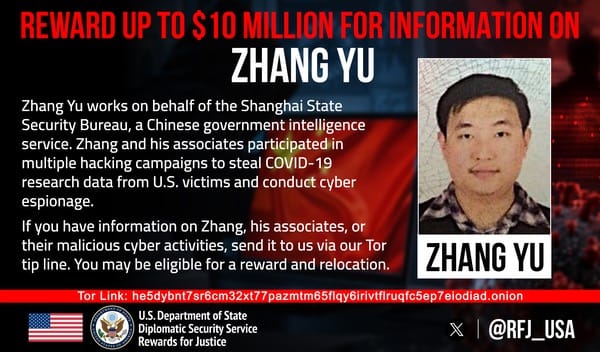
Zhang is charged alongside 34-year-old Xu Zewei with malicious cyber activity against US computer systems between February 2020 and June 2021.
According to the Rewards for Justice bounty, from early 2020 Zhang and Xu allegedly stole data - including research on COVID-19 vaccines - from the email accounts of immunologists, virologists, and US universities, at the behest of China.
The following the year the pair allegedly exploited vulnerabilities in Microsoft Exchange Server to steal further information. Once the flaws became public knowledge, other cybercriminal groups and state-sponsored hackers are thought to have also targeted hundreds of thousands of unpatched servers. Victims included the European Banking Authority.
US authorities claim that China uses private companies like Shanghai Firetech and Xu's Shanghai Powerock Network to spy and steal sensitive information, whilst at the same time obscuring the government's involvement in hacking.
Even if somebody provides information about Zhang's location it does not mean that he will be brought to court. Zhang is believed to be in China, which will not extradite its citizens - especially not one who is alleged to have been spying on its behalf on adversaries.
Furthermore, if findings by security firm SentinelOne are to be believed, Zhang's Shanghai Firetech filed multiple software patents about extract data from computers.
That's not to say, of course, that the alleged hackers can breathe easy. Xu, for instance, was arrested at Milan airport in July 2025 and extradited to the United States in April this year.
Xu has pleaded not guilty, saying that he was in Italy on holiday with his wife and that the police have detained the wrong man. China's Foreign Ministry opposed Xu's extradition, accusing the United States of fabricating charges against him.
So, if nothing else, a bounty of up to US $10 million for information about Zhang makes his future foreign travel an increasingly risky proposition, and gives anyone who has knowledge about his future holiday plans a good incentive to talk.
tags
Author

Graham Cluley is an award-winning security blogger, researcher and public speaker. He has been working in the computer security industry since the early 1990s.
View all postsYou might also like
Bookmarks
